


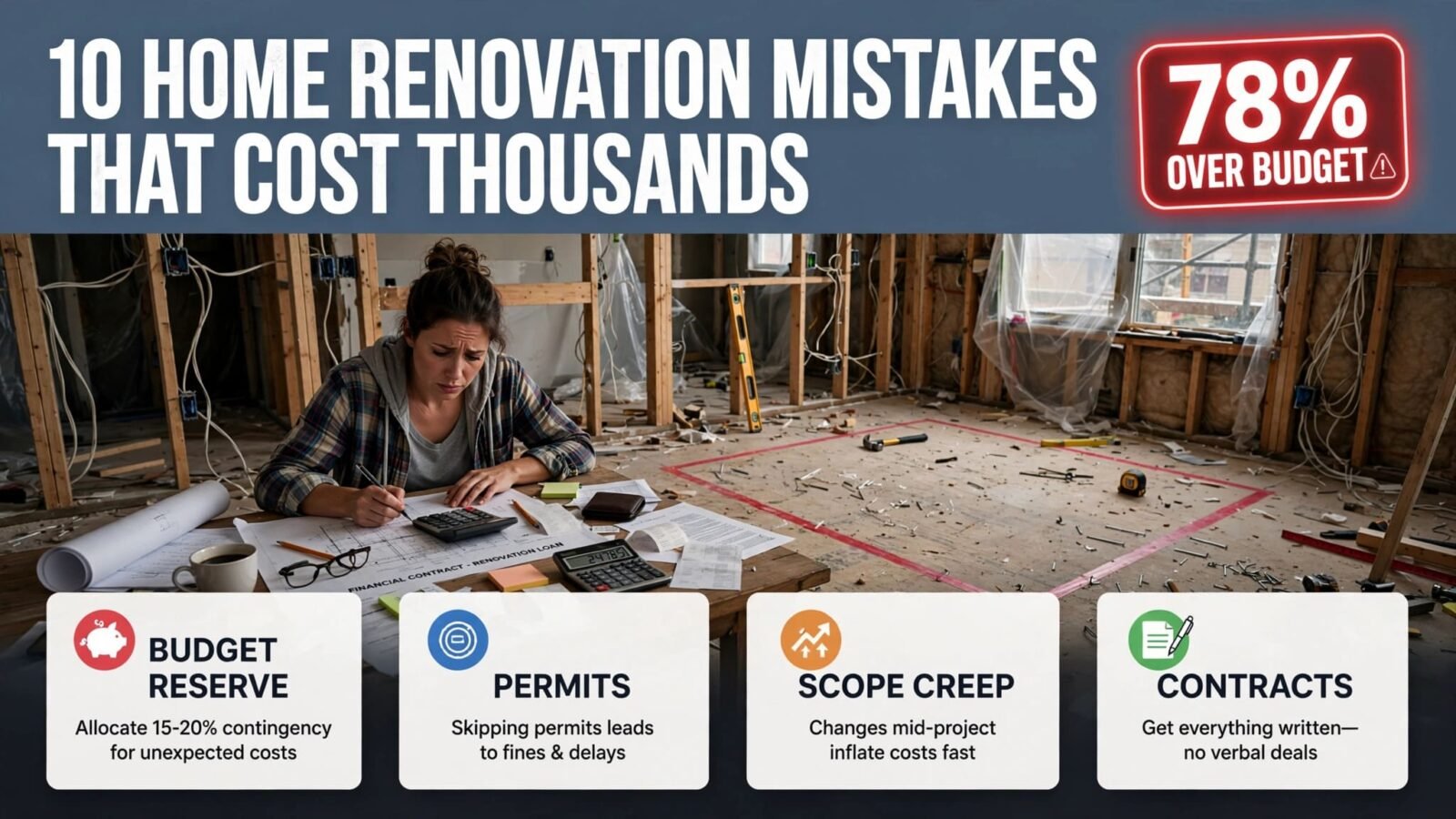
Most renovation regrets are not about paint colors. They are about money, timing, and decisions made too fast. A Clever Real Estate survey, reported by Now BAM, found that 78% of homeowners went over budget on their last renovation. It also found that 44% went over by at least $5,000, and 35% by $10,000 or more.
Houzz data points the same way. In the 2026 Houzz & Home Study, 37% of renovating homeowners exceeded their budget in 2025. This guide covers the 10 mistakes behind most of those overruns, with practical fixes for each.
| Quick Answer
The most costly mistakes are no budget or reserve, scope creep, hiring on price alone, no written contract, skipped permits, ignoring hidden problems, late decisions, moving plumbing without need, DIY beyond your skill, and over-improving for your market. Fixing them costs little. A written plan and a 10% to 20% reserve prevent most of the damage. |
| Key Takeaways
⬤ Houzz: 37% of renovating homeowners went over budget in 2025, and 25% had no budget at all. ⬤ The top overrun causes were upgraded materials (35%) and expanded scope (31%). ⬤ Complexity (32%) and hidden problems found mid-project (22%) also drove overruns. ⬤ A written contract, a verified license, and a limited deposit protect you. ⬤ Midrange projects usually return more of their cost than upscale ones. |
Mistake 1: Starting Without a Budget or a Reserve
Houzz found that 25% of homeowners did not set a budget at all. Among those who did, 37% went over it. Only 35% finished on budget, and just 3% finished under.
Renovation costs move for reasons you cannot see on day one. Houzz says 32% of overruns came from unexpected complexity, and 22% came from construction issues found once work started. That is why you need a reserve.
| The Fix
Set a total budget and keep 10% to 20% aside as a reserve. The reserve is not part of your plan. It is insurance. If you do not use it, you keep it. |
Mistake 2: Letting the Scope Grow
Scope creep is the quiet budget killer. Houzz found that 35% of homeowners went over budget because they chose higher-end materials than planned, and 31% expanded the project mid-renovation. Both are choices, not accidents.
It starts small: “While the walls are open, let us also move the outlet.” Each add-on feels reasonable. Together they can add thousands.
| The Fix
Write the scope before you start, and list what is not included. Use a change-order rule: any new request gets a written price before work begins. Decide on a “wish list” that you only fund from savings. |
Mistake 3: Hiring on Price Alone
The lowest quote can be the most expensive one. A quote with little detail may leave out items that appear later as extra charges. The FTC advises homeowners to get written estimates, check qualifications such as licensing, ask for references, and check the contractor’s online reputation.
| The Fix
Get three itemized quotes with the same scope. Compare line items, not only totals. Verify the license with your state or local agency, ask for proof of insurance, and call references. |
Mistake 4: No Written Contract, or Paying Too Much Up Front
A handshake deal is hard to enforce. The FTC says your contract should include the contractor’s name, address, phone, and license number, the start and finish dates, the payment schedule, and any promises made during conversations. It should have no blank spaces.
Deposits matter too. California law limits a down payment to 10% of the job or $1,000, whichever is less. Other states differ, and Fairfax County, Virginia advises that a deposit should typically be no more than 25% to 30%. The FTC says to limit your down payment and not to pay in cash.
| The Fix
Get a written contract. Tie payments to finished work. Pay by check or credit card. Do not make the final payment until you have checked the work, the permits, and the written warranties. |
Also ask about lien waivers. In many states, a subcontractor or supplier who is not paid can file a mechanic’s lien against your home, even if you paid the contractor. A lien release shows they were paid.
Mistake 5: Skipping Permits
Permits feel like paperwork, but they exist to check safety. Electrical, plumbing, structural, and egress changes commonly need them. Skipping a permit can lead to fines, forced removal of finished work, or trouble when you sell the home or file an insurance claim.
| The Fix
Call your building department before you start. Ask who pulls the permit. The FTC notes that a reputable contractor should get the necessary permits or ask you to get them. |
Mistake 6: Ignoring Hidden Problems
Old homes hide things: rot, outdated wiring, moisture, and hazardous materials. Houzz found that 22% of overruns came from construction issues discovered after work began.
- Check basements and bathrooms for stains, musty smells, and soft spots before you finish over them. See our guide to basement waterproofing before finishing.
- EPA guidance, repeated by public health agencies, says to test before and after finishing a basement.
- Lead paint. If your home was built before 1978, EPA lead-safe rules apply to firms working for pay. Test before you sand or demolish.
| The Fix
Inspect first. Ask your contractor to open a small test area early, and keep your reserve ready for what you find. |
Mistake 7: Making Decisions Too Late
Late choices cause delays and rush fees. Cabinets, windows, and special tile can take weeks to arrive. If an item arrives late, workers wait, and the schedule slips. Prices also move. A 25% Section 232 tariff has applied to imported kitchen cabinets and vanities since October 14, 2025, and an increase to 50% is scheduled for January 1, 2027.
| The Fix
Choose and order major items before demolition. Ask suppliers for lead times and how long a quote is valid. Check current trade rules before you place a large order. |
Mistake 8: Moving Plumbing and Layout Without a Strong Reason
Moving a sink, toilet, or shower changes pipes, drains, and often the floor structure. One lender’s 2026 cost guide estimates $2,500 to $7,000 to relocate plumbing for a new bathroom layout. Houzz found that 40% of renovating bathroom homeowners rework the layout and 38% modify walls, so this is a common choice. It is also an expensive one.
| The Fix
Ask one question: “What problem does the new layout solve?” If the answer is only taste, consider keeping the fixtures where they are and spending the money on finishes. |
Mistake 9: Doing DIY Beyond Your Skill
DIY can save real money. NerdWallet puts labor at 40% to 65% of a bathroom remodel. But some work is a poor fit for beginners: electrical, gas, structural changes, and shower waterproofing. A mistake here is not only costly. It can be unsafe.
| The Fix
Do the low-risk finish work yourself, and hire licensed pros for work involving fire, water, or structure. See our full guide to DIY vs hiring a contractor. |
Mistake 10: Over-Improving for Your Market
A luxury finish does not always return its cost. The 2025 Cost vs. Value report shows the pattern clearly:
| Project | Average cost | Resale value | Cost recouped |
| Midrange bath remodel | $26,138 | $20,915 | 80% |
| Upscale bath remodel | $81,612 | $34,000 | 42% |
| Minor kitchen remodel (midrange) | $28,458 | $32,141 | 113% |
| Major kitchen remodel (midrange) | $82,793 | $42,130 | 51% |
| Major kitchen remodel (upscale) | $164,104 | $58,561 | 36% |
These are national averages for standard projects, and your local market will differ. Still, the direction is clear: smart, midrange work tends to return more of its cost than top-tier work. If you plan to stay for many years, personal use matters too. But if you plan to sell, spend with care.
| The Fix
Look at the homes around yours. Match the finish level to your neighborhood, and ask a local agent what buyers there expect. |
Warning Signs During the Project
Even a good plan can drift. Watch for these signals while work is under way, and act early.
- Work stops for days without a reason. Ask for a written schedule update.
- Requests for more money before the work is done. Compare the request with your payment schedule and contract.
- Changes you did not approve. Ask for a written change order before accepting the cost.
- No inspections are scheduled for work that needs them.
- Materials differ from the contract. Check brand, model, and finish before they are installed.
Raise problems in writing and keep copies of messages, receipts, and photos. Clear records make it easier to settle a dispute, and they help if you later need to contact your state licensing board or a consumer agency.
Quick Reference: Mistakes, Costs, and Fixes
| Mistake | What the data shows | Best fix |
| No budget or reserve | 25% set no budget; 37% went over | Budget plus 10% to 20% reserve |
| Scope creep | 35% upgraded materials; 31% expanded scope | Written scope and change orders |
| Hiring on price | FTC advises estimates, license, references | Three itemized quotes |
| No contract or big deposit | California caps deposits at 10% or $1,000 | Written contract, staged payments |
| Skipped permits | Needed for most electrical, plumbing, structure | Call your building department |
| Hidden problems | 22% of overruns came from issues found mid-project | Inspect early, keep a reserve |
| Late decisions | Tariffs and lead times change cost and schedule | Order before demolition |
| Moving plumbing | One guide: $2,500 to $7,000 | Keep fixtures where they are |
| DIY beyond skill | Labor is 40% to 65% in a bath, but risk is high | DIY safe tasks only |
| Over-improving | Upscale bath recoups 42% versus 80% midrange | Match your market |
Step-by-Step: A Safer Renovation Plan
- Define the scope in writing, including what is not included.
- Set a budget and a 10% to 20% reserve.
- Inspect for hidden problems such as moisture, wiring, and older materials.
- Get three itemized quotes and verify licenses and insurance.
- Sign a written contract with a payment schedule and a limited deposit.
- Confirm permits and who will pull them.
- Choose and order major items before demolition.
- Check the work before the final payment, and collect warranties and lien releases.
Frequently Asked Questions
What is the most expensive home renovation mistake?
There is no single answer, but the biggest ones are starting without a clear budget and scope, hiring without a written contract, and ignoring hidden problems such as water damage. Houzz found that 37% of renovating homeowners went over budget in 2025.
How much should I keep as a renovation reserve?
A common rule of thumb is 10% to 20% of the budget. The NKBA Kitchen Planner suggests this range for kitchens. Houzz found that only 3% of homeowners finished under budget.
Do I really need a permit?
For most structural, electrical, plumbing, and egress work, yes. Rules differ by city and county, so call your local building department. Permits protect you at resale and with insurance.
Should I pay a contractor a big deposit?
No. The FTC advises you to limit the down payment and check your state’s rules. California, for example, caps it at 10% or $1,000, whichever is less. Do not pay in cash, and do not let payments get ahead of the work.
How do I avoid going over budget?
Set a clear scope, choose all materials before work begins, get itemized written quotes, and keep a reserve. Houzz found that upgrading materials and expanding scope mid-project were two of the top reasons for overruns.
Is it a mistake to renovate before selling?
Not always, but spend carefully. The 2025 Cost vs. Value report shows that midrange projects often recoup more of their cost than upscale ones. A midrange bath remodel recouped 80%, and an upscale one recouped 42%.
The Bottom Line
Most renovation overspending is predictable. It comes from a missing budget, a growing scope, weak contracts, skipped checks, and late decisions. None of these needs special skill to fix. They need a written plan, a reserve, and a little patience before work begins.