


A finished basement can add living space, but only if it stays dry. If water gets behind new walls and floors, you pay twice: once to build and again to tear it out. So the smartest question before you finish a basement is not “What flooring do I want?” It is “Is this basement really dry?”
This guide explains what waterproofing is, how to tell if you need it, what it costs in 2026, and the order of steps that protects your money. You will also see when you can safely skip it.
Quick Answer
You need waterproofing before finishing if water enters the basement or the walls and floor stay damp. If the basement passes the tests below, you may only need good outside drainage and moisture-smart finishes.
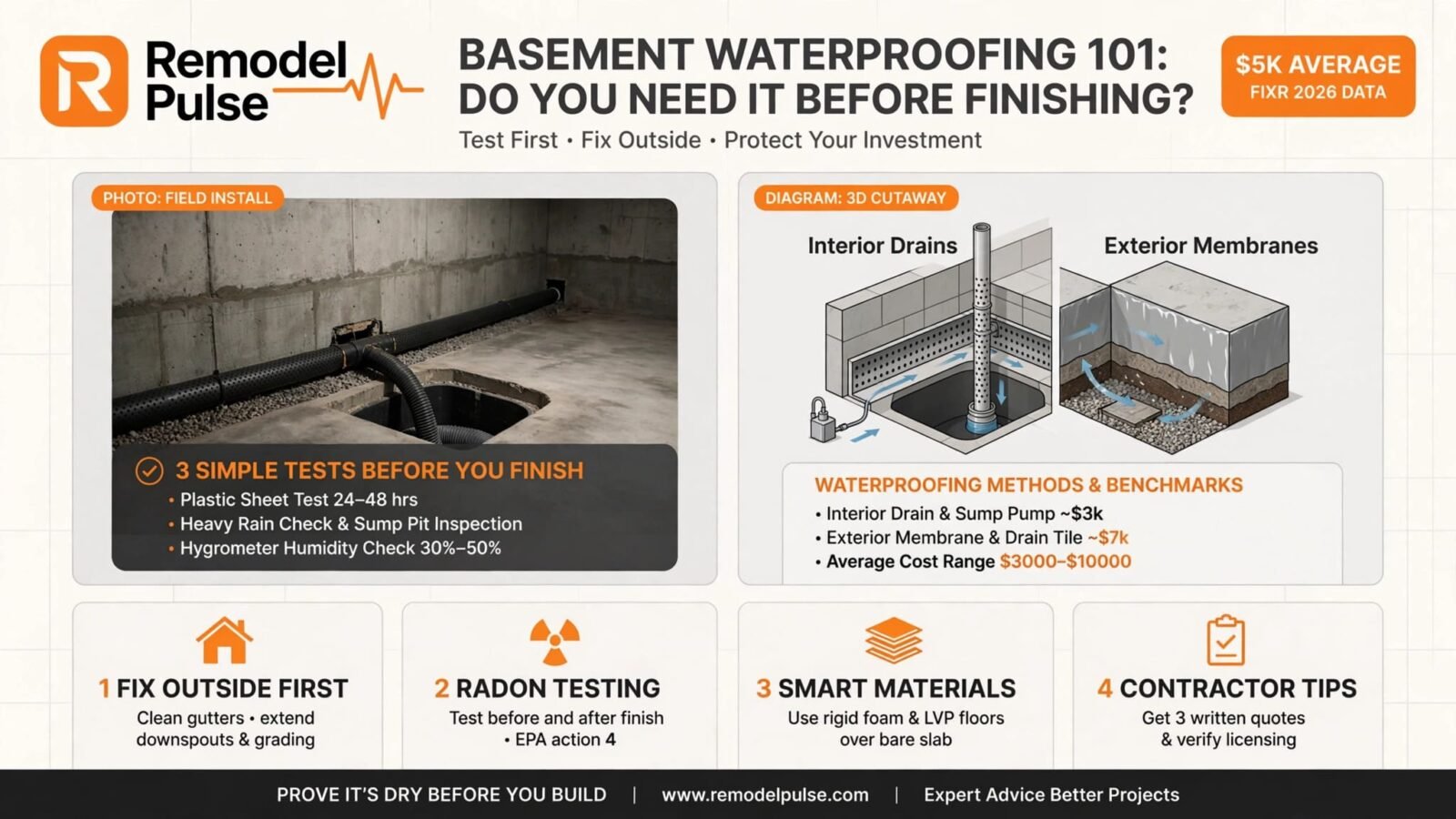
Fixr’s 2026 guide lists an average cost of $5,000, and most homeowners pay $3,000 to $10,000.
Key Takeaways
- Test first. Do not finish a basement that is damp, leaking, or musty.
- Fix the outside first: gutters, downspouts, and grading are the cheapest cures.
- Fixr’s 2026 average is $5,000, and most jobs cost $3,000 to $10,000.
- Interior systems manage water that gets in. Exterior systems keep it out.
- Test for radon before and after you finish. Keep humidity below 60%, and ideally between 30% and 50%.
Waterproofing, Dampproofing, and Moisture Control: What Is the Difference?
These words are often mixed up. They mean different things.
| Term | What it does | Typical examples |
|---|---|---|
| Dampproofing | Slows moisture moving through concrete. It does not stop water under pressure. | Asphalt or cement-based coatings applied during construction |
| Waterproofing | Blocks or manages liquid water that pushes against the foundation. | Exterior membranes, drain tile, interior drains, sump pumps |
| Moisture control | Manages humidity and condensation inside the space. | Dehumidifier, vapor barriers, insulation, ventilation |
Building codes generally call for dampproofing of basement walls, and for waterproofing where the water table is high or soil conditions are severe. That is why some basements are fine with basic protection and others need a full system. Your local rules and your soil decide the answer.
Where Basement Water Comes From
You cannot fix a problem you do not understand. Basement moisture usually comes from one or more of these sources:
- Surface water. Rain runs toward the house because of poor grading, short downspouts, or clogged gutters.
- Groundwater. After heavy rain, water in the soil pushes against the foundation. This is called hydrostatic pressure, and it can force water through cracks and joints.
- Window wells. Wells without drains or covers can fill with water and leak into the basement.
- Plumbing leaks. A leaking pipe or water heater can look like a foundation problem.
- Condensation and humidity. Warm, humid air meets cool concrete and leaves water on the surface.
The right fix depends on the source. A dehumidifier will not stop a crack from leaking, and a drain system will not fix a plumbing leak.
How to Tell If You Need Waterproofing
Look for the warning signs
- Water stains, damp patches, or standing water after rain.
- White, chalky powder on concrete or block walls.
- A musty smell, mold, or mildew.
- Peeling paint or bubbling wall coatings.
- Rust on metal items near the floor, or a rusty furnace base.
- A sump pump that runs often.
- Horizontal cracks, bowing walls, or stair-step cracks in block. These can signal a structural problem, so call an engineer or foundation specialist.
Do three simple tests
These tests cost almost nothing, and they give you real evidence.
- The plastic sheet test. Tape a 2 by 2 foot piece of plastic tightly to a concrete wall or floor, sealing all edges. Wait 24 to 48 hours. If moisture forms on the room side, you have a humidity or condensation issue. If moisture forms under the plastic, moisture is coming through the concrete.
- The rain test. Check the basement during and after a heavy rain. Look at wall bases, floor cracks, window wells, and the sump pit.
- A humidity reading. Use a low-cost hygrometer. The U.S. EPA advises keeping indoor humidity below 60%, and ideally between 30% and 50%.
Also Test for Radon
Radon is a separate issue, but it belongs in this plan. The EPA action level is 4 pCi/L, and it suggests considering action between 2 and 4. EPA guidance, repeated by the California Department of Public Health, says to test before and after finishing a basement. Some drain and sump systems can be tied into a radon system, so ask your contractor.
Start With the Cheapest Fixes: The Outside
Most basement water problems start outdoors. These fixes cost far less than a full system and may solve the problem alone.
- Clean gutters and repair leaks.
- Extend downspouts so they discharge well away from the foundation.
- Regrade the soil. The International Residential Code calls for the ground to fall at least 6 inches in the first 10 feet away from the foundation.
- Fix window wells. Add covers and make sure the wells drain.
- Seal visible cracks in walkways and patios that tilt toward the house.
- Repair plumbing leaks before you blame the foundation.
After these steps, wait for a few heavy rains and test again. Many homeowners find the basement is now dry. If it is not, you have better information to give a contractor.
Waterproofing Methods Compared
If outside fixes are not enough, there are three main approaches. Many jobs combine them.
| Method | How it works | Pros and cons |
|---|---|---|
| Interior drain and sump pump | A drain along the inside of the footing collects water and sends it to a sump pit, where a pump removes it. | Pro: lower cost and no digging outside. Con: it manages water that has entered, not water at the wall. |
| Exterior membrane and drain tile | The soil is dug away, the wall is sealed, and drain tile carries water away. | Pro: keeps water out. Con: higher cost, digging, and landscape repair. |
| Crack repair and coatings | Cracks are injected or sealed, and a coating is applied. | Pro: low cost for minor issues. Con: may not stop water under pressure. |
| Humidity control | A dehumidifier and a vapor-smart finish manage moisture in the air. | Pro: low cost. Con: it does not stop liquid water. |
A Fixr 2026 guide notes that exterior methods are more effective than reactive interior steps such as a dehumidifier, though those interior steps cost less. This Old House describes the same split: interior methods manage water already inside, while exterior methods prevent water from entering.
What Waterproofing Costs in 2026
Costs vary by method, basement size, soil, and access. Here are the main benchmarks.
| Source | Number |
|---|---|
| Fixr, February 2026: average cost | $5,000 |
| Fixr, February 2026: most homeowners pay | $3,000 to $10,000 |
| Fixr, February 2026: per square foot | $3 to $10 |
| Angi 2026 basement remodel data: waterproofing when needed | $5 to $10 per square foot |
| This Old House, March 2026: interior methods average (1,000 sq ft) | About $3,000 |
| This Old House, March 2026: exterior methods average (1,000 sq ft) | About $7,000 |
You may also see higher totals. This Old House lists a full price range of $12,447 to $14,833 for a 1,000 square foot basement, which reflects larger scopes with multiple parts. The lesson: ask what each quote includes. A drain-only price and a full-system price are not the same product.
How to Compare Quotes
- Ask for a written diagnosis that explains where the water comes from.
- Compare the scope: drain, pump, backup power, crack repair, and cleanup.
- Ask for the warranty in writing, and ask if it transfers to a buyer.
- Get at least three quotes, and be careful with pressure to sign the same day.
Do You Need It Before Finishing? A Simple Decision Guide
Use this table to match your situation to an action.
| Your situation | What to do before finishing |
|---|---|
| Dry in every test, no history of water | Fix gutters and grading, keep a dehumidifier ready, and use moisture-smart finishes. |
| Damp walls or musty smell, but no standing water | Fix outside drainage, add humidity control, and retest. Consider interior sealing or a drain if it continues. |
| Seepage after heavy rain | Fix it first. Get a written diagnosis, and consider a drain system with a sump pump. |
| Standing water or past flooding | Do not finish yet. Get several quotes for a full system, including a backup pump. |
| Horizontal cracks or bowing walls | Call an engineer. This may be structural, not only a water issue. |
How to Finish a Basement the Moisture-Smart Way
Even a dry basement benefits from smart materials. These choices reduce risk:
- Use rigid foam against concrete walls instead of fiberglass batts. Foam does not absorb water the way fiberglass can.
- Choose floors that tolerate moisture, such as luxury vinyl plank, porcelain tile, or carpet tiles. Angi says moisture resistance should be your top priority when you pick basement flooring.
- Avoid wall-to-wall carpet on a bare slab.
- Keep wall bottoms off the slab or use moisture-resistant materials near the floor.
- Leave access to the sump pit, shut-offs, and cleanouts.
- Plan a dehumidifier, and keep humidity below 60%, ideally between 30% and 50%.
- Test for radon before and after the finish.
Our guide to how to finish a basement family room covers design and code in more detail. If your plan includes a media room, see basement movie theater costs and design.
How to Hire a Waterproofing Contractor
Waterproofing is a specialty trade, and the sales process can be pushy. Protect yourself with the same basics the FTC advises for any contractor.
- Get three written estimates with the same scope.
- Check licensing and insurance with your state or local agency.
- Ask for references, and call them.
- Get a written contract with the scope, the payment schedule, and the warranty terms.
- Limit the down payment, and pay by check or credit card.
- Ask about permits and who pulls them.
- Check the work during a rain, and keep the paperwork for a future buyer.
Be careful with a single “free inspection” that ends in a high-pressure sale of the biggest system. A good contractor explains the cause of the water and offers options, from lower-cost fixes to full systems.
A Note on Insurance
Many standard homeowners policies do not cover flooding or groundwater seepage. Sump pump failure and sewer backup are often covered only with an added endorsement. Read your policy or ask your agent before you invest in a finished basement. This is general guidance, and policies differ.
Step-by-Step: A Dry Plan Before You Finish
- Inspect for stains, powder, odor, mold, and cracks.
- Test with the plastic sheet, a rain check, and a humidity reading.
- Fix the outside: gutters, downspouts, grading, and window wells.
- Retest after several heavy rains.
- Choose a system only if water still enters. Get three written quotes.
- Test radon, and plan a fix if needed.
- Verify the repair during a heavy rain.
- Finish with moisture-smart materials, and keep humidity in range.
Frequently Asked Questions
Do I have to waterproof my basement before finishing it?
Not always, but you must first prove it is dry. If you see seepage, standing water, or repeated dampness, fix it before you finish. If your basement passes the tests, good exterior drainage and moisture-smart finishes may be enough.
How much does basement waterproofing cost?
Fixr’s 2026 guide lists an average of $5,000, with most homeowners paying $3,000 to $10,000, or about $3 to $10 per square foot. Angi puts it at about $5 to $10 per square foot when it is needed. Other guides list higher totals for larger scopes, so get several quotes.
Can I just paint waterproofing sealer on the walls?
A coating may help with minor dampness, but it usually cannot hold back water under pressure. If water is entering, fix drainage first, then ask a pro about the right system.
What is the cheapest first step?
Fix the outside. Clean gutters, extend downspouts, and make sure the soil slopes away from the house. The International Residential Code calls for a fall of at least 6 inches in the first 10 feet.
Does homeowners insurance cover basement water damage?
Usually not for groundwater seepage or flooding. Sump pump failure and sewer backup often need an added endorsement. Read your policy or ask your agent before you finish the space.
How long does a waterproofing system last?
It depends on the system and installation. Ask for the warranty terms in writing, including whether the warranty transfers when you sell the house.
The Bottom Line
Waterproofing before finishing is not about fear. It is about order. Prove the basement is dry, fix the outside first, and spend on a system only if water still gets in. Then finish with materials that tolerate moisture, and keep humidity in range. A dry foundation protects every dollar you spend afterward.