

You paid every invoice on time. The kitchen is finished, the dust is finally gone, and you are starting to enjoy the space you spent months planning. Then, three months later, a certified letter shows up from a plumbing supplier you have never heard of. They say they still have not received $3,800-and now there is a claim against your house.
That is the unpleasant world of the mechanic’s lien-one of the least understood and possibly most expensive surprises in remodeling. For homeowners, the annoying part is this: in many states, someone else’s payment dispute can pull you in even when you paid your contractor exactly as agreed. Fortunately, this is also one of those problems where good paperwork and a few smart payment habits can greatly reduce your risk.
Below, we will walk through what a mechanic’s lien actually means, why it can appear after you have already paid, how the rules change from state to state, and the practical steps homeowners can use to protect their property before the first check-and before the final one.
The short answer
In brief
A mechanic’s lien is a legal claim on your property that someone files after doing work on your project or supplying materials and not getting paid. In most states, someone can file one even if you paid your general contractor in full. You protect yourself with a written contract, a list of everyone on the job, lien waivers with every payment, and final waivers from everyone before the last check. Laws vary a lot by state.
Important
This is general information, not legal advice. Lien rules are strict and different in every state. If you have gotten a lien or a notice, or you are planning a large project, talk to a construction attorney in your state.

What a mechanic’s lien is
A mechanic’s lien, also called a construction lien or materialman’s lien, is a legal claim that a person or company records against your property after providing labor or materials for the improvement and not getting paid. The name can confuse people-the word “mechanic” is old-fashioned here. We are not talking about someone repairing a car. The term can cover contractors, subcontractors, suppliers, and laborers who contributed to the project.
The key point for a homeowner is that the lien attaches to the property, not only to the person who hired the contractor. Once someone records it with the county, it can cloud your title and create problems when you try to sell, refinance, or close on another loan. If you and the person filing do not resolve the dispute, they may be able to sue to collect on the lien. In a worst-case situation, a court can order the sale of the property to satisfy the debt.
Why it can happen even if you paid
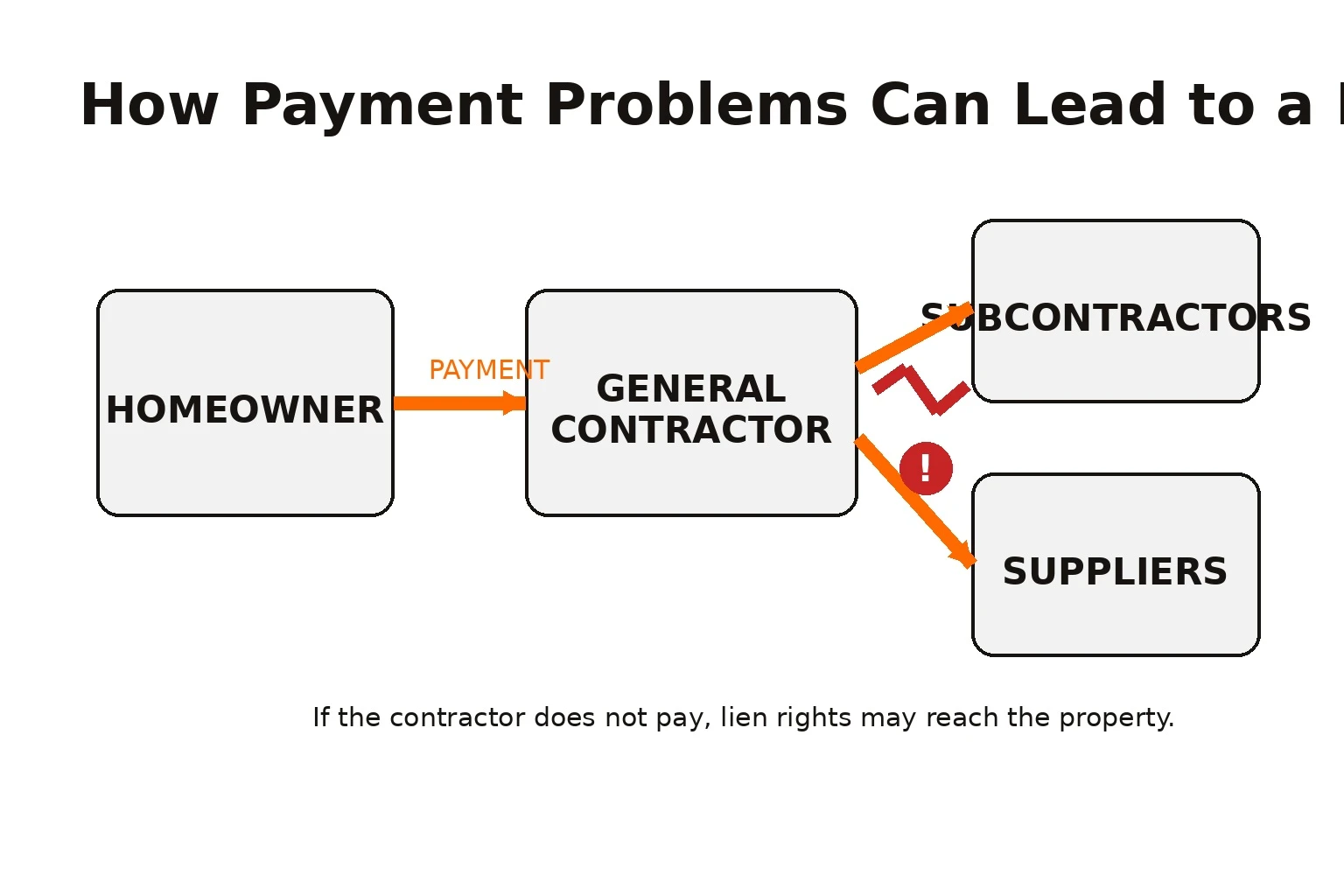
To understand why this happens, follow the money through a typical remodel. You pay the general contractor. The general contractor then pays the plumber, electrician, tile installer, cabinet supplier, and other people working behind the scenes. You may never sign a contract with those companies-or even meet them-but depending on state law, they can still have lien rights connected to your property.
Now picture a very realistic scenario. You pay a general contractor $42,000 for a kitchen remodel. You have fully paid your account with the contractor, but the contractor never sends the $3,800 it owes the plumber. The plumber did not contract with you directly, yet state lien law may still allow that plumber to make a claim against the house. From your point of view, the contractor should have handled that payment. From the plumber’s point of view, the work is in your home and the plumber still has not received payment.
For a homeowner, that can feel completely backward: “I already paid-how can I still owe anyone?” The legal idea is that the labor or materials improved the property, so the property can serve as security for payment. The system aims to protect people who contribute work and materials, but that is exactly why homeowners need to protect themselves at every payment stage too.
That brings up the next question most homeowners ask: if you only hired one contractor, who else could actually file a lien?
Who can file one
- General contractors who worked for you directly.
- Subcontractors, like plumbers, electricians, roofers, and tile setters.
- Material suppliers who delivered lumber, cabinets, fixtures, or other materials.
- Laborers hired by the contractor.
- In some states, design professionals like architects and engineers.
Who has lien rights-and what they must do to preserve them-depends heavily on state law. In some states, a contractor who is not properly licensed may lose the ability to enforce a lien. That gives homeowners one more practical reason to verify licensing before signing a contract. Our guide on what a solid contract spells out covers what to look for, including lien waivers.

Knowing who can file is useful, but the process makes much more sense when you see the order in which things usually happen.
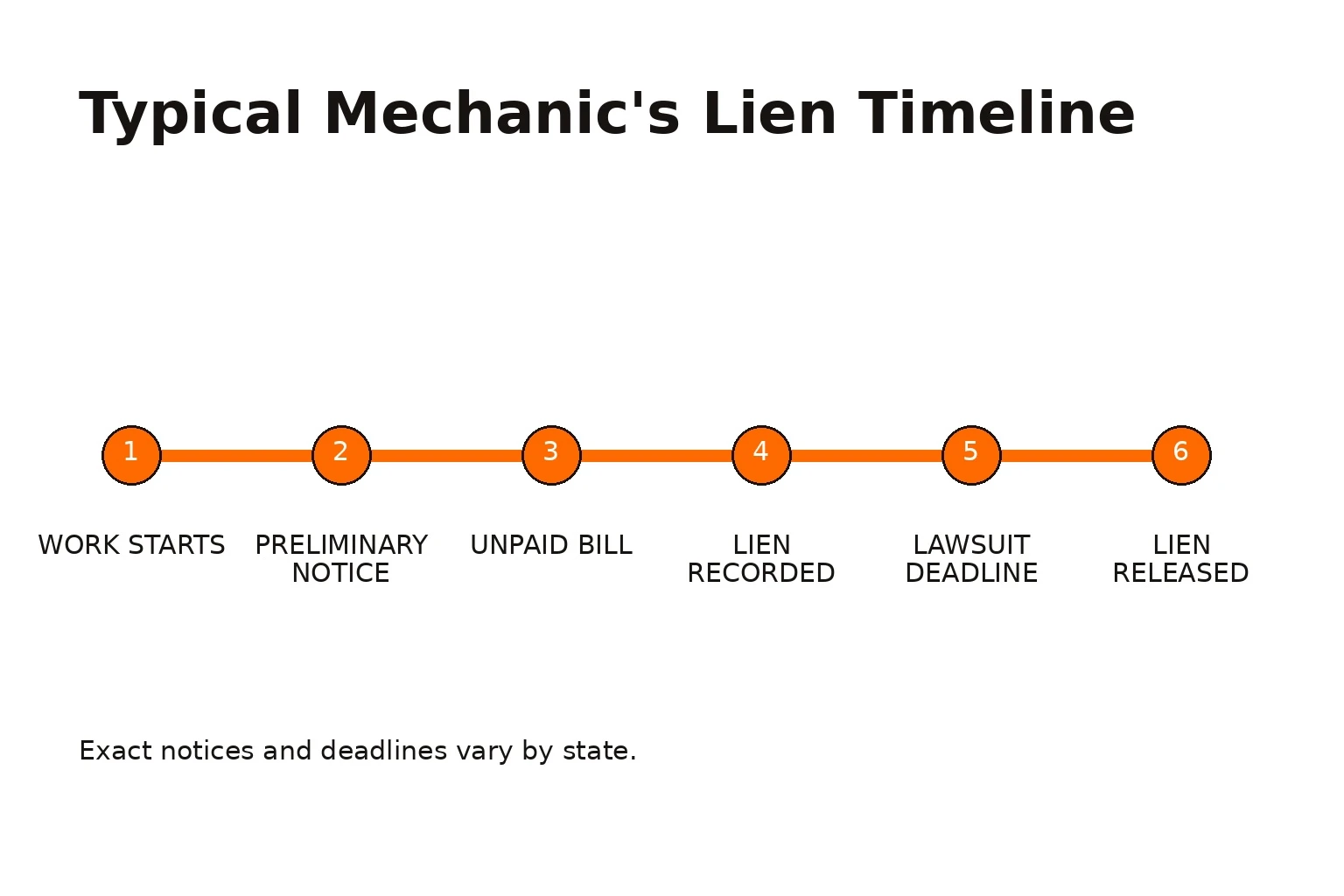
How a lien works, step by step
| Stage | What happens | Why it matters to you |
|---|---|---|
| 1. Work begins | Subcontractors and suppliers start work or deliveries. In many states, they must send you an early notice | A notice is a heads-up, not a lien |
| 2. Payment problem | A sub or supplier does not get paid | This is where trouble starts |
| 3. Lien filed | The person filing records a lien with the county, within strict deadlines | Your title now has a claim against it |
| 4. Notice to you | You usually get a copy | Do not ignore it |
| 5. Collection | If nothing gets resolved, the person filing may need to sue within a set time to collect on the lien | Missed deadlines can make a lien invalid |
| 6. Resolution | Payment, a negotiated release, a bond, a court ruling, or expiration | A recorded release clears your title |
If there is one theme that runs through lien law, it is deadlines. Notices, recording dates, completion dates, and collection deadlines can all matter. In many states, being even one day late can be enough to defeat a lien-so when a notice lands in your mailbox, the dates deserve as much attention as the dollar amount.
How it differs by state: three examples
This is where homeowners often get tripped up: there is no single national mechanic’s lien rulebook. Every state sets its own notice requirements, filing deadlines, waiver rules, and homeowner protections. The examples below show just how different the process can look. Use them as a comparison, not as a substitute for checking the rules where your property is located.
| State | Key rules (simplified) | Homeowner protection to know |
|---|---|---|
| California | Subs and suppliers must send a 20-day early notice. A lien generally gets recorded within 90 days after completion, or 30 days (subs and suppliers) or 60 days (direct contractors) after the owner records a Notice of Completion. The person filing must sue within 90 days after recording the lien. | Only four official waiver forms count. The state’s contractor board offers a free homeowner guide to preventing liens |
| Florida | Subs and suppliers must serve a Notice to Owner within 45 days of starting work. Someone records a claim of lien within 90 days of last furnishing, and must start collection within one year after recording. | Contracts over $2,500 for homes with up to four units must carry a bold lien warning. The contractor must give a Final Payment Affidavit |
| Texas | Lien filing deadlines are tied to calendar months. For owner-occupied residential projects, the deadline is generally the 15th day of the third month after the debt accrues. | Owners must hold back 10 percent of the contract price for 30 days after completion. That rule protects owners from many sub and supplier liens. Homestead rules add more requirements |
You can read the California Contractors State License Board’s guide to preventing mechanics liens, and Florida’s official contract warning rule. For other states, start with your state’s contractor licensing board and attorney general’s consumer office, and use USA.gov’s state consumer directory to find them.
A preliminary notice is not a lien
A letter labeled “Preliminary Notice,” “Notice to Owner,” or “20-Day Notice” can look worrying, especially when you are not expecting it. But receiving one does not automatically mean there is a mechanic’s lien on your house. California’s contractor board makes the distinction clearly: a preliminary notice is not a lien. It is basically the sender saying, “We are part of this project, and we may have lien rights if we do not get paid.”
In fact, that notice can be useful. It gives you the name of a subcontractor or supplier who may otherwise be hidden from you, which means you now know whose payment you should cover with a waiver later. Keep every notice and use it as part of your project paper trail. Then do three things:
- Write down the name, the date, and what they supplied.
- Tell your contractor you received it, and ask for a lien waiver from that company when payment is made.
- Do not pay twice. Paying that company directly, if your state allows it and your contractor has not paid, may be an option, but ask a professional first.

Notices tell you who is on the job. Waivers are how you document that those people actually get paid.
Lien waivers explained
If mechanic’s liens are the risk, lien waivers are the everyday tool homeowners can use to control that risk. A lien waiver is a signed document in which a contractor, subcontractor, or supplier gives up lien rights, usually in connection with a specific payment. Think of it as a receipt with legal muscle. There are two main waiver types and two common payment stages to understand.
| Type | What it says | When to use it |
|---|---|---|
| Conditional waiver | Releases lien rights once the payment actually clears | Before you pay, so you can hand over the check at the same time |
| Unconditional waiver | Releases lien rights now, with no condition | After the payment has cleared, never before |
| Progress waiver | Covers the work and payment for a stage | With each progress payment |
| Final waiver | Covers everything through the end of the job | With the last payment |
- Collect them from everyone, not just the general contractor. Subs and suppliers are the ones who can file liens.
- Match the amounts and dates. The waiver should show the payment and the period it covers.
- Never accept a blank or undated waiver.
- Use the right form. In California, only the four official forms count. Other states have their own rules.
- Keep copies of everything. They prove all trades got paid if you sell later.

The easiest way to use all of this information is to turn it into a routine. You do not need to become a lien-law expert; you need a repeatable process before, during, and at the end of the project.
Your protection checklist
Before you sign
- Check the contractor’s license and insurance with your state board.
- Put the contract in writing, with the scope, price, and payment schedule.
- Ask for a list of every subcontractor and major supplier.
- Add a clause that requires lien waivers with each payment and final waivers at the end.
- Ask for a written warranty and a cleanup plan.
During the job
- Tie payments to finished work, not dates. See planning payments and a holdback for how.
- Before each payment, get conditional waivers from the contractor and from anyone who has started work.
- Pay by check or bank transfer so there is a record, never in cash.
- Watch for preliminary notices, and keep them.
- Put changes in writing. Documenting extra work properly avoids disputes that can lead to unpaid bills.
At the end
- Get final unconditional waivers from the contractor and every sub and supplier before you make the last payment.
- Hold back a portion until the final inspection, and check your state’s rules. Texas, for example, requires a 10 percent holdback for 30 days.
- Use your state’s closing steps, like a Notice of Completion in California or a Final Payment Affidavit in Florida.
- Close out permits and inspections. See closing out permits and inspections.
- Consider a title check on your property to confirm no one recorded liens.
One more practical point: if you will be living in the house during construction, sort out the insurance side before demolition starts-not after a problem appears. Insurance checks before work begins covers coverage questions.

Even with good planning, a lien or lien notice can still show up. If it does, the goal is to respond quickly, stay organized, and avoid making a second payment before you understand what happened.
What to do if you get a lien
Immediate steps to take
- Do not ignore it. Deadlines matter, and ignoring a lien rarely makes it go away.
- Read it carefully. Note who filed it, the amount, the dates, and what work it covers.
- Check the paperwork. Did you receive a preliminary notice? Is the amount right? Did they file it on time?
- Contact your general contractor in writing and demand that they pay the person filing and get the lien released. Keep copies.
- Talk to the person filing. Sometimes a quick conversation shows what is unpaid.
- Compare it to your payments. If you have paid the contractor in full and have waivers, collect them. If you still owe the contractor money, some states let you pay the person filing directly and deduct it, but check the law first.
- Call a construction attorney. Options may include disputing an invalid lien, negotiating, or posting a bond to release the lien from your property so you can sell or refinance.
- Get a recorded release once you resolve the matter, so your title is clear.
If the lien is not resolved quickly
If you are planning to sell or refinance, do not leave a lien issue for the closing table. A title search is likely to uncover any recorded claim, and last-minute surprises can delay a transaction fast. Good project records help here too, and keeping records that help at sale explains why receipts and waivers matter for taxes too.
A lot of homeowner mistakes start with one of a few very reasonable-sounding assumptions. Here are the ones worth clearing up before they cost you money.
Myths vs facts
| The myth | The fact |
|---|---|
| “I paid my contractor in full, so I’m safe.” | In most states, a sub or supplier who did not get paid can still file a lien. Waivers from everyone are what protect you. |
| “A preliminary notice means a lien is on my house.” | It does not. It is a heads-up that preserves the sender’s rights. |
| “The contractor’s signature on a waiver is enough.” | Subs and suppliers can have their own rights, so you want their waivers too. |
| “Liens last forever.” | In many states they expire if the person filing does not sue in time. California requires suing within 90 days of recording, and Florida allows one year. |
| “Only big projects get liens.” | Someone can lien smaller jobs too. Protect yourself on every project that involves more than one trade. |
If you are skimming because a notice just arrived, these are the questions homeowners usually want answered first.
Frequently asked questions
Can a contractor put a lien on my house if I paid them?
The contractor you paid usually cannot, but their subcontractors and suppliers often can if they did not get paid. That is why lien waivers from everyone matter.
What is a mechanic’s lien in simple terms?
It is a legal claim against your property by someone who did work or supplied materials on it and has not received payment. It can make it hard to sell or refinance until you resolve it.
How long does a mechanic’s lien last?
It depends on your state. Many liens expire if the person filing does not file a lawsuit within a set time, such as 90 days after recording in California or one year in Florida. Never rely on a lien disappearing on its own.
What is a lien waiver, and do I need one?
It is a signed document in which a contractor, subcontractor, or supplier gives up lien rights. Yes, collect them. Use conditional waivers before you pay and unconditional waivers after the payment clears.
Can I remove a mechanic’s lien?
Yes, in several ways: the person filing gets paid and records a release, you dispute an invalid lien, you post a bond in states that allow it, or a court rules on it. A construction attorney can tell you what applies in your state.
Does a lien affect my credit?
A lien itself is a claim against your property, not a credit item. But it can block a sale or refinance, and a court judgment from an unpaid claim could affect you. Resolve it quickly.
Final thoughts
Nobody wants to think about lien law while choosing tile, comparing cabinet colors, or waiting for countertops. But the best time to prevent a mechanic’s lien is long before there is a dispute. A simple habit-asking for the right paperwork before money changes hands-can protect you from one of remodeling’s most annoying surprises. It also sets a clear expectation from day one: this project will be documented, organized, and paid properly.
So build the protection into your contract, keep every notice that arrives, collect waivers as payments are made, and do not rush the final check just because the project looks finished. A little paperwork during the remodel can mean a lot more peace of mind after it. Then you can enjoy the new kitchen, bathroom, addition, or renovation knowing the project is truly closed out-not just visually complete.

Keep planning your project
More practical, plain-English guides on costs, permits, design, and hiring from the RemodelPulse team.