

Basement Movie Theater: Is It Actually Worth It?
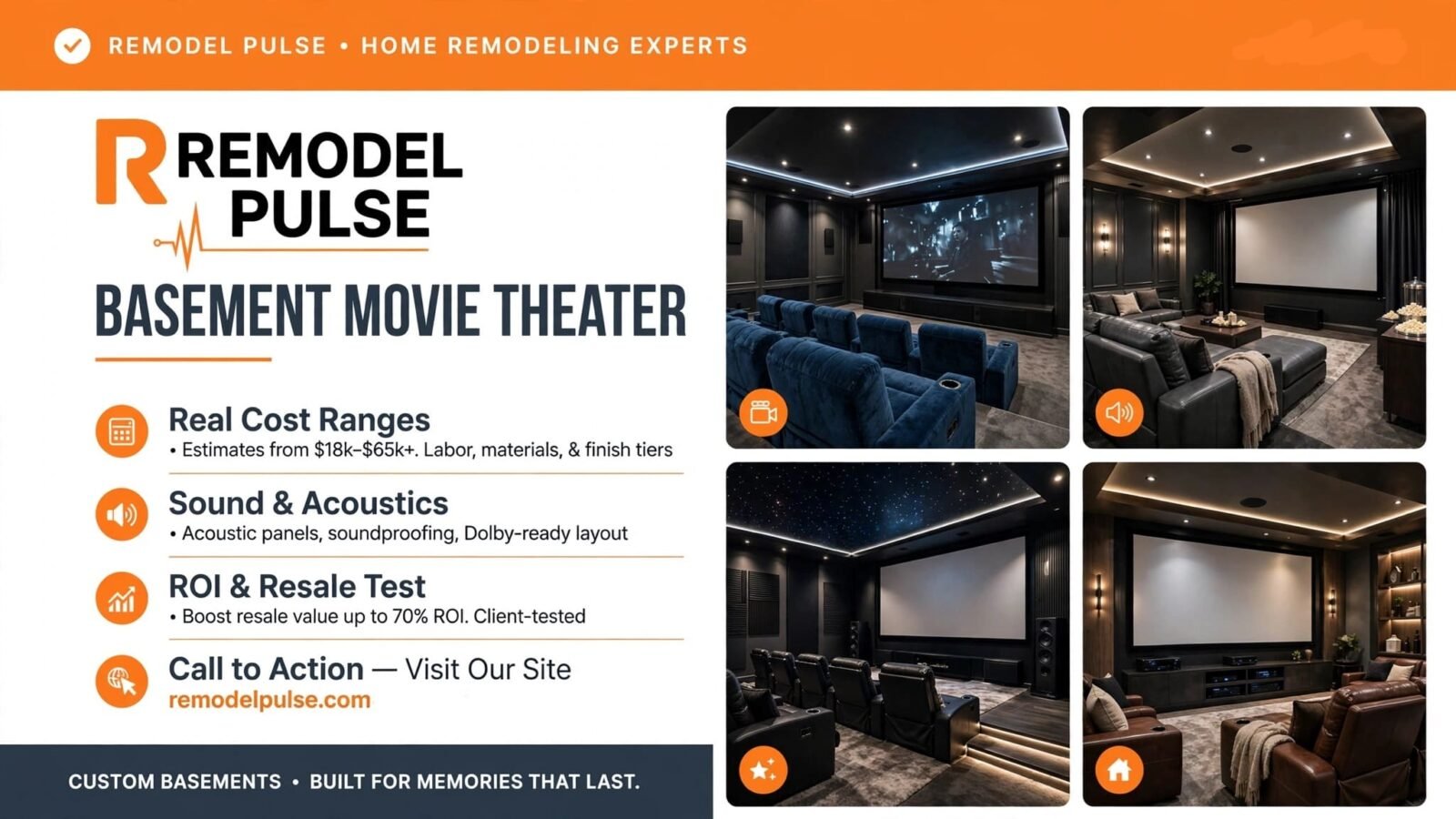
A movie room is one of the most popular basement dreams. The data shows real interest. Yelp reported that project requests for home theater installations rose 562% in 2024 compared with 2023, and its searches for basement remodels rose 155%. CE Pro’s 2025 market research found that basements accounted for 45.6% of home theater installs.
But a popular idea is not always a good fit. A theater costs money, needs careful planning, and can be too narrow for resale. This guide gives you real cost ranges, design math, and a simple test to decide if a basement movie theater is worth it for you.
Is the Basement Theater Trend Real?
Yes, with some limits on how to read the numbers. Here is what we could confirm:
| Finding | Source |
|---|---|
| Home theater installation project requests up 562% in 2024 vs 2023 | Yelp trend report, as reported by Axios and CE Pro |
| Basement remodel searches up 155% | Yelp, same report |
| Basements made up 45.6% of home theater installs | CE Pro 2025 Home Entertainment market research |
| “Home theater” searches up 44% in 2022; “basement games room” up 1,267% | Houzz, 2022 search data |
Notice what is missing: a verified “100% year-over-year” Houzz figure for “basement movie theater.” We could not confirm that number, so we do not use it. The sources above are real, but they cover different years and different measures. Read them as proof of strong interest, not as a single exact growth rate.
CE Pro’s research also shows a shift. Dedicated theater rooms still make up the biggest share of projects, but multipurpose media rooms are rising. That is worth remembering when you plan your space.
How Much Does a Basement Movie Theater Cost?
Costs vary a lot, so use ranges and ask for quotes. A Fixr cost guide for home theater rooms lists these figures:
| Item | Typical cost |
|---|---|
| Basic conversion with basic equipment, no risers, minimal soundproofing | Around $10,000 |
| Average basement theater conversion | $40,000 to $60,000 |
| Full addition with carpet, risers, seating, lighting, soundproofing, and top equipment | Around $90,000 |
| Soundproofing | $1,000 to $5,000 |
| Projector screen | $20 to $1,000 |
Many other cost sites publish very different ranges, and some are not clear about their method. So treat any single number as a rough guide. Your total depends on four main drivers: the display, the sound system, the room finish, and seating.
Do not forget the basement itself
If your basement is not finished yet, add the cost of the finish. Angi’s 2026 data lists a full basement remodel at $30 to $75 per square foot. A 14 by 20 foot room is 280 square feet, which means about $8,400 to $21,000 for the shell alone, before theater equipment. That is our calculation, not a quote.
Before You Build: Moisture, Radon, and Code
Equipment and soft finishes do not like water. Do these checks first.
- Moisture. Look for stains, white powder on concrete, or a musty smell. Fix the cause first. See our guide to basement waterproofing before finishing.
- Radon. The EPA action level is 4 pCi/L, and EPA suggests considering action between 2 and 4. Test before you start and again after the finish is done.
- Ceiling height. Many codes require at least 7 feet in finished living areas. A projector, soffits, and raised seating all reduce headroom.
- Egress. A basement with living space needs an emergency escape opening. If a guest sleeps there, the rule applies to the sleeping room.
- Permits. Electrical and framing work usually need permits and inspections.
For the full basics, read our guide to how to finish a basement family room.
Design: Screen Size, Seating, and Distance
The most common mistake is buying a screen first and fitting the room later. Start with the room.
Match screen size to seating distance
Many designers use a viewing angle of about 30 to 40 degrees. Based on that rule, here are the seating distances for common 16:9 screens. These are our calculations from the screen geometry.
| Screen size (diagonal) | Screen width | Distance for 40 degrees | Distance for 30 degrees |
|---|---|---|---|
| 100 inch | 87 inches | About 10.0 feet | About 13.6 feet |
| 120 inch | 105 inches | About 12.0 feet | About 16.3 feet |
| 135 inch | 118 inches | About 13.5 feet | About 18.3 feet |
So a 120 inch screen suits a room about 14 to 20 feet long, once you allow space behind the seats. A small basement room may fit a 100 inch screen better than a giant one.
Plan seating and layout
Use fewer, better seats. Allow clear walkways, and keep seats away from the side walls, where sound and picture quality drop. If you want raised seating for the back row, check ceiling height first.
Control the light
A projector needs a dark room. Use dark, matte walls and ceiling near the screen, and put lighting on dimmers. Cover or block basement windows. Add low-level lights for safe steps.
Choose projector or TV
A projector gives a larger picture for the price, but needs a dark room. A big TV handles light better but is limited in size. If your basement is bright or multi-use, a TV can be the more flexible choice.
Sound: Isolation vs Acoustics
These are two different jobs, and many people mix them up.
| Sound isolation | Room acoustics |
|---|---|
| Goal: keep sound in the theater. Tools: extra drywall layers, sealed gaps, insulated ceiling, solid doors. Plan it before walls are closed. Matters most if bedrooms are above. |
Goal: make sound better inside the room. Tools: acoustic panels, bass traps, rugs, soft seating. Can be added later in stages. Matters most for dialogue and clarity. |
Sound isolation works best when you stop sound paths. Seal gaps around outlets, ducts, and doors. Add insulation in the ceiling joists. Use a solid door with good seals. Fixr lists soundproofing at $1,000 to $5,000 in its example costs, so budget for it early. It is much cheaper to add now than after the finish is complete.
Is It Actually Worth It? A Simple Test
Worth is personal, but you can test it with numbers and honest answers.
The cost-per-use test
Divide the total cost by the number of times you will use the room. Here is an example. Say the build costs $25,000, and you use it twice a week for 10 years. That is about 1,040 uses, so the cost is about $24 per use. If you will use it only a few times a year, the cost per use is far higher. This is a simple example, not a prediction. Use your own numbers.
The resale test
No major national study, such as the Cost vs. Value report, tracks home theaters, so we cannot give you a resale percentage. Some buyers love a theater. Others see a dark room they must convert. If you may sell within five years, a flexible media room with good wiring and lighting may be wiser than a fully custom theater.
The use test
Ask who will use it, how often, and for what. If the room will also host game nights, kids, and sports, plan for a multipurpose design. CE Pro research points to a rise in multipurpose media rooms for this reason.
Ways to Build a Theater for Less
- Start with the room, then add equipment later. Wiring and sound isolation are hard to add after the finish.
- Choose a smaller screen that fits your seating distance.
- Skip risers unless you need them. They add cost and use headroom.
- Phase the project. Build the shell and wiring now, then add a better projector and speakers later.
- Do safe DIY tasks, such as painting and acoustic panels. Hire licensed pros for electrical work. See our guide to DIY vs hiring a contractor.
- Get three written quotes with the same scope.
Step-by-Step: Plan Your Basement Theater
- Check moisture and radon. Fix problems first.
- Measure the room and find the lowest beams, ducts, and pipes.
- Check code and permits for ceiling height, egress, and electrical.
- Choose the screen and seating distance using the table above.
- Plan sound isolation, wiring, lighting, and HVAC before framing.
- Set a budget and a 10% to 20% reserve.
- Build the shell, then add equipment and acoustic treatment.
- Retest radon and calibrate the system after the finish.
Frequently Asked Questions
How much does a basement movie theater cost?
One Fixr cost guide puts a basement conversion at an average of $40,000 to $60,000, with a low end near $10,000 for a basic setup with minimal soundproofing. That is on top of any basement finishing you still need. Costs depend on screen type, sound system, seating, and soundproofing.
Do I need soundproofing for a basement theater?
If the theater is below bedrooms or living areas, yes. Sound isolation keeps noise in the room. Fixr lists soundproofing at $1,000 to $5,000 in its example costs. Plan it before walls and ceilings are closed.
What is the best screen size for a basement theater?
It depends on seating distance. Many designers aim for a viewing angle of about 30 to 40 degrees. For a 120 inch 16:9 screen, that means a seating distance of about 12 to 16 feet.
Does a basement theater add value to my home?
There is no major national study, such as Cost vs. Value, that tracks home theaters. A theater can attract some buyers and put off others. A flexible media room is a safer choice if resale matters.
Can I put a theater in a basement with a low ceiling?
It is harder. Many codes require at least 7 feet of finished height in living areas. Raised seating and a ceiling-mounted projector both reduce usable height. Ask your building department how they measure it.
Projector or TV for a basement theater?
A projector gives a larger picture for the price but needs a dark room. A large TV handles light better but is limited in size. Basements are good for projectors because you can control light.
The Bottom Line
A basement movie theater is worth it for people who will use it often and plan it well. The trend is real, but trends do not pay for your build. Dry walls, safe air, correct code, sound isolation, and a screen sized to the room matter more than the latest projector.
Sources
- Axios, More people are going to movie theaters in their homes (June 29, 2025), reporting Yelp data
- CE Pro, Searches for Home Theater Installers Surged 562% in 2024, According to Yelp; CE Pro Home Entertainment Deep Dive 2025
- Houzz, 3 Ways Homeowners Are Getting Rooms Ready for the Holidays (2022 search data)
- Fixr, Home Theater Room Addition cost guide
- Angi, How Much Does Basement Remodeling Cost (2026 data)
- California Department of Public Health, Radon Testing (EPA guidance)
- Local building department basement guides based on the International Residential Code