

Every house wears down. That part is normal. The hard part is knowing when normal wear has turned into “we should really do something about this.” Some signs are loud, like a ceiling stain that keeps coming back. Others are quiet, like a bathroom fan that has stopped doing its job or an outlet that has always felt a little warm.
This guide walks through nine signs that it is time to renovate, what each one usually means, and how to decide what to tackle first. It is written for ordinary homeowners, not contractors, so you will find plain explanations and a few honest warnings about where people tend to get burned.
The short version
Fix anything that affects safety, water, or structure first. Then upgrade the systems that quietly cost you money every month. Leave the pure looks for last. If two or more signs below sound like your house, it is worth getting a professional opinion before another year goes by.
1. The layout fights how you actually live
Think about the last week. Did you squeeze past the same corner ten times? Do you carry laundry up two flights because the machine lives in the basement? Does the dining table block the hallway whenever you have guests?
When a house is designed around a lifestyle that is not yours, you adapt without noticing. You stop using a room, or you use it for something it was never meant for. That is a real cost, even though it never shows up on a bill.
Layout problems are also the ones people put off the longest, because they sound like luxuries. They are not always. A kitchen with no counter space near the stove is a daily annoyance and, in some cases, a safety issue. A bedroom that can only fit the bed one way is a design problem you can fix.
Quick test
Walk through your home and write down every spot where you say “I wish this were different.” If the same complaint shows up three times, it is probably a layout issue worth planning for.
Be aware that moving walls is where permits and structural questions begin. Before you fall in love with an open-concept idea, read our guide on home renovation permits, because a wall that looks decorative can be carrying the roof.
2. You keep repairing the same things
A single repair is maintenance. Repeated repairs on the same system are a message.
Maybe you have patched the same drywall crack three springs in a row. Maybe the water heater has been serviced twice in two years, or the back door has been re-hung, re-caulked, and re-painted and still sticks every August. Each fix feels cheap on its own. Add them up over a few years and you may have paid for half a replacement without getting one.
A simple rule many remodelers use: if repair costs on one item are creeping toward half the price of replacing it, and the item is already old, replacement is usually the smarter call. It is not a law of nature, but it is a useful gut check.
Keep a running list of what you fix and what it costs. After a year you will see patterns. The pattern is your renovation plan, already written.
3. Your electrical system is showing its age
This one deserves extra attention, because the risks are higher than a bad paint job.
Signs your wiring or panel needs a look
- Lights that flicker or dim when an appliance turns on
- Breakers that trip often, or fuses that blow regularly
- Outlets that feel warm, buzz, or have scorch marks
- Two-prong outlets and a house that runs on extension cords and power strips
- A small or crowded electrical panel that cannot keep up with modern use
Age matters too. Home inspectors point to two older wiring types in particular. Knob-and-tube wiring was used from about the 1880s into the 1940s, and its old insulation can break down over time. Single-strand aluminum wiring was used in some homes built from roughly the mid-1960s to the early 1970s. Aluminum can overheat at connections if it was not installed with the right parts. Neither one automatically means disaster, but both are worth having a licensed electrician evaluate.
There is a money angle as well. Some insurance carriers refuse to cover homes with active knob-and-tube wiring, or charge noticeably more for it. A full rewire can run from a few thousand dollars to well over thirty thousand, depending on the size of the home and how hard the walls are to open. That is a big range, which is exactly why you want a written quote before you plan around it.
Heads up
Electrical work is one of the clearest cases where you should hire a licensed professional and pull a permit. Do not guess here. A hidden wiring problem is a fire risk, not just an inconvenience.
4. Water pressure, pipes, and slow drains
Plumbing is another system that fails quietly. By the time you see a leak, the pipe has usually been struggling for a while.
Watch for weak water pressure at multiple faucets, brownish or rusty water when you first turn on a tap, drains that gurgle or back up, and damp spots under sinks or around the base of toilets. Those are all clues.
Material and age give you more clues. Galvanized steel pipes, common in older homes, corrode from the inside out. Over decades the inside of the pipe narrows, which is why pressure drops long before anything leaks. Polybutylene pipes, used in some homes in the late twentieth century, have a reputation for sudden leaks. Homes built into the late 1940s may even have lead pipes or lead-containing parts, which is a health concern that filters alone do not fully solve.
If you are not sure what your pipes are made of, a plumber can tell you in one visit. Knowing is useful even if you are not planning a project yet, because it changes how you budget for any bathroom or kitchen work down the road.
5. Moisture, mold, and musty smells
If you take only one thing from this article, take this: never paint over a water stain and call it fixed.
Stains on ceilings, bubbling paint, warped baseboards, a soft spot in the floor, or a persistent musty smell all point to water getting somewhere it should not. The source could be a roof leak, a failing window seal, a plumbing drip inside a wall, poor grading outside, or high humidity with no ventilation.
The reason this is urgent is that water damage is cumulative. A small leak that goes unnoticed for months can rot framing and feed mold, and the repair bill grows quietly the entire time. Finding and stopping the source comes before any cosmetic renovation, every time.
Common culprits to check
- Bathroom fans that are weak, noisy, or vent into the attic instead of outdoors
- Cracked or missing caulk around tubs, showers, and windows
- Gutters that overflow or downspouts that dump water next to the foundation
- Basement walls that feel damp or show white, chalky residue
Basements deserve their own attention because moisture there is so common. If yours is one of the rooms you have been thinking of finishing, sort out the water first. Finishing over a damp wall is how people end up tearing out brand-new drywall.
6. Drafts, uneven rooms, and high energy bills
Does one bedroom stay freezing in winter and roast in summer? Do you feel a breeze near a closed window? Are your utility bills climbing even though your habits have not changed?
Older homes were generally not built to today’s energy standards, which means air leaks, thin insulation, and tired windows can quietly add to your monthly costs. Often the biggest wins are not glamorous: air sealing, attic insulation, and replacing a few failing windows or doors.
The nice thing about this category is that the improvement shows up as comfort first and savings second. You feel it the first cold night after the work is done.
7. Kitchen or bathroom parts are failing
Kitchens and bathrooms take the most abuse in a house, because they combine water, heat, and constant use. They also tend to be the rooms where small failures turn into bigger ones.
| What you notice | What it may mean | What to do |
|---|---|---|
| Soft or spongy floor near the toilet or tub | Slow leak or rot under the floor | Stop using that fixture and have it inspected promptly |
| Cabinet doors sagging, drawers dropping, swollen bases | Moisture damage or worn-out hardware | Replace hardware first; if boxes are swollen, plan to replace cabinets |
| Cracked tile or grout that keeps coming back | Movement or water getting behind the tile | Check the substrate before re-tiling over it |
| Peeling or bubbling paint in the bathroom | Poor ventilation | Fix the fan or vent before repainting |
| Countertop seams lifting or edges swelling | Water getting under the surface | Reseal if early; replace if the core is damaged |
There is encouraging news if you are on the fence about cost. Remodeling’s Cost vs. Value report has found that minor kitchen remodels, such as new cabinet fronts, hardware, and fixtures, tend to recoup a larger share of their cost at resale than major, high-end overhauls. Mid-range bathroom remodels have also posted some of their best return numbers in years, at roughly 80 percent of cost in the 2025 report. Your results will depend on your local market, so treat those as directional rather than guaranteed.
If your bathroom is small and the problem is mostly that it feels tight, these small bathroom remodel ideas can help you stretch every inch before you commit to a bigger project.
8. Your life changed and the house didn’t
A house that worked perfectly five years ago can stop working without a single thing breaking.
- A growing family needs more bedrooms, bathrooms, or storage
- Working from home may call for a real office, not the end of the dining table
- Aging in place can mean a curbless shower, grab-bar blocking in the walls, wider doorways, or a main-floor bedroom
- Adult kids or relatives moving in can turn a basement or garage into a priority
The question is not whether your house is good. It is whether it is good for the life you have now. Plan for the next ten years rather than the last ten. It is much cheaper to include blocking for future grab bars while the walls are open than to open them again later.
9. You love the area but not the house
This is the emotional sign, and it is a legitimate one. Many people stay where they are because of schools, neighbors, commute, or simply because they like the street. If the neighborhood is right and the house is wrong, renovating can make more sense than moving, especially when you factor in agent fees, closing costs, and a new mortgage rate.
That said, run the numbers honestly. If the changes you want would push your home well beyond what similar houses on your street sell for, you may not get that money back. Plenty of people renovate for comfort and are happy with that. Just go in knowing which kind of project it is: an investment, or a lifestyle upgrade you are choosing on purpose.
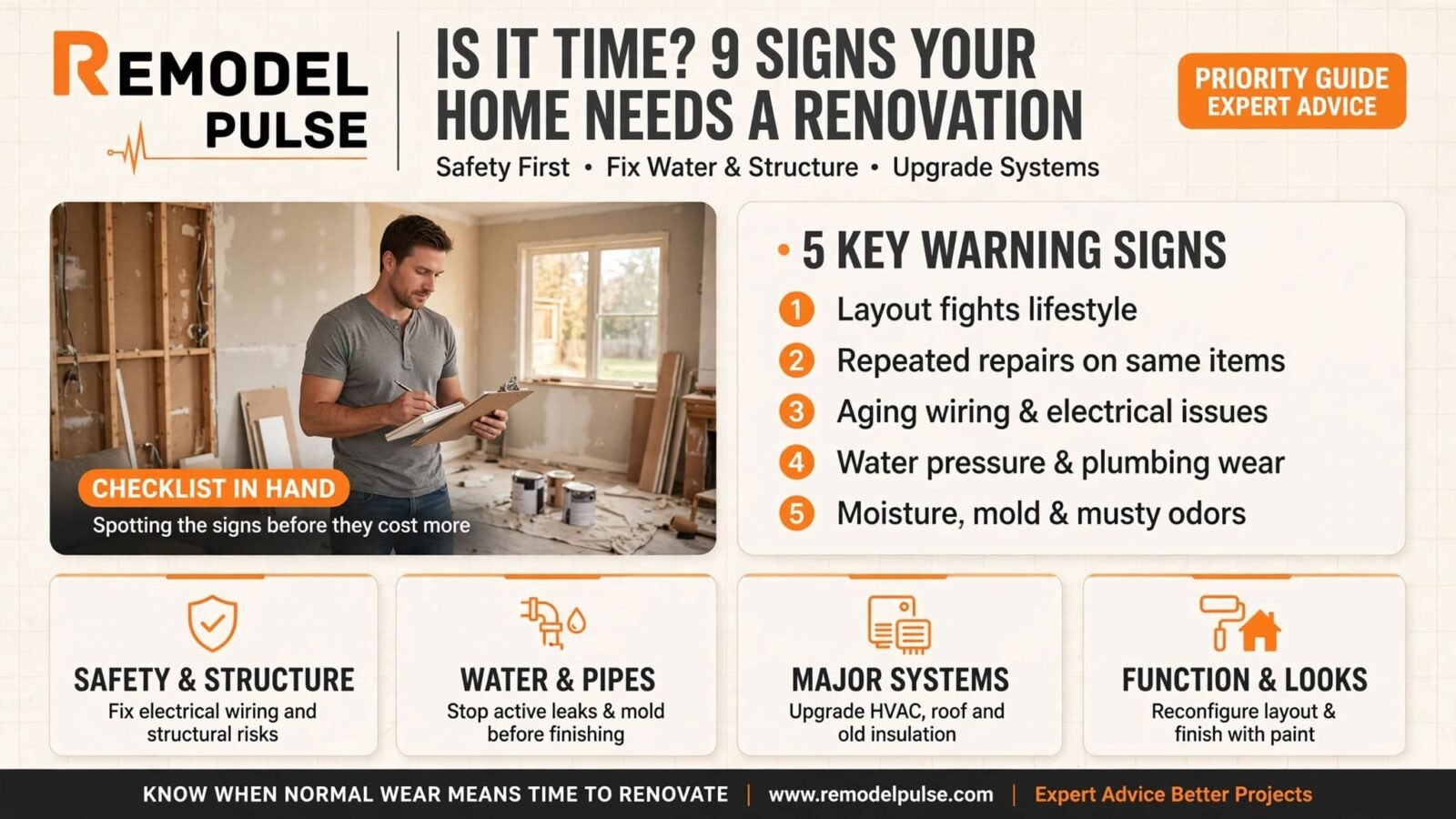
What to fix first: a simple priority order
When several signs show up at once, the list gets overwhelming. This order keeps you from spending on looks while something more serious is waiting behind a wall.
| Priority | Examples | Why it comes here |
|---|---|---|
| 1. Safety | Faulty wiring, gas or carbon monoxide concerns, lead paint or asbestos disturbed by work, structural cracks | Protects people and can affect insurance |
| 2. Water and structure | Roof leaks, plumbing leaks, mold, foundation moisture, rot | Damage compounds while you wait |
| 3. Major systems | Panel, old plumbing, HVAC near end of life, insulation, windows | Saves money and prevents emergency failures |
| 4. Function | Layout, storage, bathrooms, kitchen workflow | Improves daily life once the house is sound |
| 5. Looks | Paint, flooring, finishes, fixtures | Best done last so nobody tears it up for plumbing |
A note on older homes
If your house was built before 1978, lead-based paint may be present. Federal rules require lead-safe work practices for many renovation projects in older homes, so tell any contractor the age of your house up front. You can read more at the EPA lead page.
How to actually start
- Do a slow walkthrough. Go room by room with a notebook and phone. Photograph stains, cracks, and anything that makes you say “hmm.”
- Get the hidden stuff inspected. A home inspector, electrician, or plumber can look at the systems you cannot see. A few hundred dollars here can save you from planning a project around the wrong problem.
- Set a budget and a cushion. Most remodelers suggest holding back roughly 10 to 20 percent for surprises, especially in older houses. Walls hide things.
- Get written quotes. Compare at least three, and learn to read them. Our guide on how to read a contractor quote explains what to look for.
- Check permits early. Know what your city requires before you sign anything. The permits guide covers the basics.
If cabinets are part of your plan, it also helps to understand your buying options early. Our comparison of RTA vs assembled cabinets shows where the real savings and trade-offs are.
Frequently asked questions
How do I know if my house needs a full renovation or just repairs?
Look at patterns. If problems are isolated, such as one leaky faucet or one cracked tile, repairs are usually enough. If you have several aging systems at once, or repairs keep recurring in the same place, a larger renovation may be cheaper and less frustrating in the long run. A professional inspection can confirm which category you are in.
Which warning sign is the most urgent?
Anything involving electrical hazards, active water leaks, mold, gas smells, or structural movement should be treated as urgent. Cosmetic issues can wait. Safety and water problems should not.
Is it better to renovate or move?
It depends on your numbers and your feelings about the location. Renovating avoids moving costs and a new mortgage rate, and you keep the neighborhood you like. Moving can be better if the changes you need are huge or would push your home’s value far past nearby sales.
How much should I set aside for unexpected problems?
Many remodelers recommend a cushion of about 10 to 20 percent of the project budget. Older homes tend to need the higher end, because hidden wiring, pipes, and rot only show up once walls are open.
Do I need a permit for renovation work?
Often yes, especially for structural, electrical, and plumbing changes. Cosmetic updates like painting or swapping cabinets without moving plumbing or wiring usually do not. Rules vary by city, so check with your local building department before you start.
Final thoughts
Most houses do not need a dramatic overhaul. They need attention in the right order. Start with safety and water, move on to the systems that quietly cost you money, then fix the way the house works for you, and finish with the pretty parts.
If you recognized your home in more than one of the signs above, that is not a reason to panic. It is a reason to get a clear picture, a written plan, and a budget with some breathing room. You will feel better the moment the plan is on paper.