



First, the quote arrives: $48,000 for the kitchen. Then you nod politely, thank the contractor, and walk out to the driveway with a quiet, slightly dizzy thought: how does anyone pay for this?
It is a fair question, and it matters more than the tile. After all, design choices can be changed. However, a bad financing choice follows you for years, sometimes with your house attached to it. Fortunately, the options are few, the rules are knowable, and a calm side-by-side comparison beats panic every time.
So this guide walks through every real way to pay for a renovation in the United States, what each one costs right now, what each one risks, and how to protect yourself. It uses published data and names its sources. Because rates were checked in early November 2026 and they move often, treat every rate as a snapshot and confirm current numbers with a licensed lender before you borrow.
Start here: the short version
Please read this first
This is general information, not financial, tax, or legal advice. After all, your credit, income, equity, and state all change the answer. Therefore, before you borrow against your home, talk to a licensed lender. Also, for tax questions, talk to a tax professional. Finally, always confirm current rates, loan limits, and program rules – the numbers below are snapshots only.
The short answer
First, savings are the cheapest way to pay, and most homeowners use them: about 84 percent of renovators in Houzz’s 2025 study. However, if you must borrow, loans secured by your home usually cost less than cards or personal loans, but they put your house on the line. In fact, the higher the interest rate, the more important a short payoff plan becomes. Therefore, borrow only what a written quote plus a 10 to 20 percent cushion requires, and test your payment at a higher rate.
Key takeaways
- First, pay with savings when you can keep your emergency fund intact.
- Second, home-secured options (HELOC, home equity loan, cash-out refinance) usually carry lower rates than personal loans or credit cards – but your house is collateral.
- Also, always get written contractor quotes, add a 10-20% cushion, and test the payment at a rate 2 points higher than today’s.
- In addition, interest on a HELOC or home equity loan is tax-deductible only if the money is used to buy, build, or substantially improve the home that secures the loan – and only if you itemize.
- Finally, you generally have three business days to cancel a home-secured loan on your primary residence after you sign.

How homeowners actually pay
Of course, before comparing loans, it helps to know what other homeowners really do.
- First, savings lead. The 2025 Houzz & Home Study found that 84 percent of renovating homeowners used savings, and Bankrate reported that 81 percent of those doing major projects between $50,000 and $200,000 paid with cash savings, with credit cards a distant second at 26 percent.
- However, cards are common. In Houzz’s 2026 Renovation Trends survey, 34 percent of homeowners used credit cards, usually in combination with other money.
- Meanwhile, big projects mix sources. For budgets over $50,000, 23 percent used home equity loans and 20 percent used cash from a home sale.
- Finally, overspending is normal. Houzz found that 35 percent of homeowners went over budget by choosing pricier materials, and 31 percent expanded the project mid-renovation.
That last point is the one to remember. In fact, many people borrow for the quote and then spend beyond it. Therefore, build your cushion into the loan amount from day one.
What borrowing costs right now
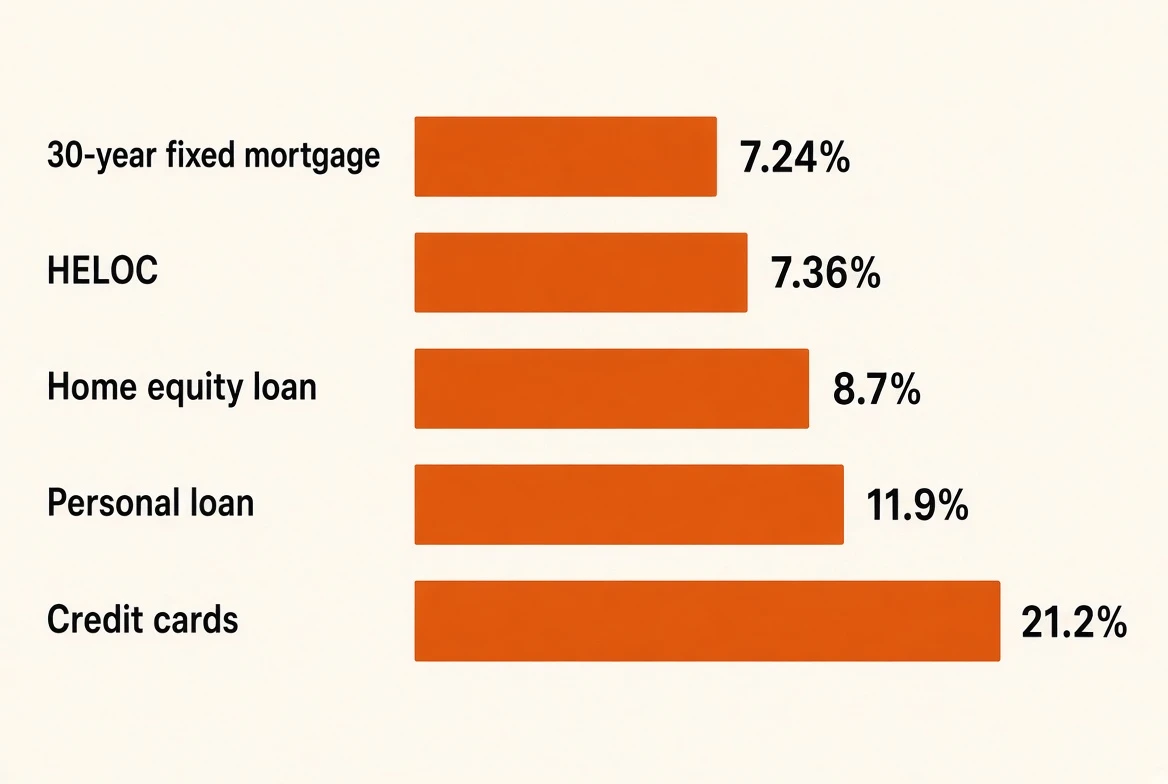
These are national averages as of early November 2026 (latest available weekly or quarterly data). However, your offer can be higher or lower depending on your credit score, income, equity, and lender. Because rates move frequently, always get a current quote.
| Type of borrowing | Recent average | Source / date |
|---|---|---|
| 30-year fixed mortgage | About 7.24% | Freddie Mac, week ending October 29, 2026 |
| HELOC (variable) | About 7.36% | Bankrate national survey, late October 2026 |
| Home equity loan (fixed) | About 8.7% | Bankrate national survey, late October 2026 |
| 24-month personal loan | About 11.9% | Federal Reserve G.19, latest available 2026 data |
| Credit cards | About 21.2% on all accounts; about 22.4% on accounts that pay interest | Federal Reserve G.19, latest available 2026 data |
For example, you can check current figures at Freddie Mac’s weekly survey, Bankrate’s HELOC rates, and the Federal Reserve’s consumer credit release. Therefore, always confirm the exact rate and terms with your lender.
Your options, one by one
1. Savings
First, savings offer no interest, no application, and no risk to your house. However, the catch is opportunity: money spent is not available later. Therefore, many advisers suggest keeping an emergency fund of three to six months of living costs, so avoid draining it for a kitchen.
2. Home equity line of credit (HELOC)
Second, a HELOC is a revolving credit line secured by your home. You draw what you need during a “draw period,” often paying only interest, and then repay during a repayment period. However, rates are typically variable, so your payment can rise. Lenders commonly limit total borrowing to around 80 to 85 percent of your home’s value, counting your mortgage. For details, the Consumer Financial Protection Bureau explains how HELOCs work on its HELOC page.
- Good for: projects paid in stages, since you borrow as you go.
- Watch out for: rising rates, interest-only payments that leave the balance untouched, and fees. Therefore, confirm current rate caps and draw-period terms with the lender.
3. Home equity loan
Third, this is a one-time lump sum, secured by your home, usually with a fixed rate and fixed payments. It is easier to budget than a HELOC, but you pay interest on the whole amount from day one.
- Good for: a single project with a clear price.
- Watch out for: closing costs and the fact that your house secures it.
4. Cash-out refinance
Fourth, you replace your current mortgage with a bigger one and take the difference in cash. That means the new rate applies to your whole balance. With the average 30-year rate around 7.24 percent, giving up a lower existing mortgage rate to fund a remodel can be costly, so run the full math. In addition, refinance closing costs are often several thousand dollars.
- Good for: people whose current rate is higher than today’s, or who need a large amount.
- Watch out for: resetting your loan term and losing a low rate. Therefore, confirm the full before-and-after payment with a lender.
5. Personal loan
Fifth, this is an unsecured loan, so your house is not collateral. The trade-off is a higher rate than home-secured options, and some lenders charge origination fees. Payments are fixed, and terms are usually a few years.
- Good for: smaller projects, or people without much equity.
- Watch out for: fees and higher monthly payments from short terms.
6. Credit cards and 0 percent offers
Sixth, cards are fast and flexible, but interest averages above 21 percent. A 0 percent promotional offer can work if, and only if, you pay the balance before the promotion ends. Some store cards use deferred interest, which can charge interest back to the purchase date if you miss the deadline. Therefore, read the terms closely.
- Good for: small costs you can pay off quickly, or purchases with built-in protections.
- Watch out for: carrying a balance past the promotion.
7. Renovation mortgages
Seventh, if you are buying a home that needs work, or refinancing, a renovation mortgage rolls the costs into one loan based on the home’s “as-completed” value. Program rules and limits change, so always confirm the current details with a lender experienced in these products.
- FHA 203(k). A Limited version covers up to $75,000 in non-structural repairs under current lender guides. A Standard version has a $5,000 minimum, allows structural work, and requires a HUD-approved consultant. Loans stay within county FHA limits, which in 2026 range from about $541,287 (most areas) to $1,249,125 (high-cost areas) for a single-family home.
- Fannie Mae HomeStyle and Freddie Mac CHOICERenovation. Renovation costs are generally capped at 75 percent of the “as-completed” appraised value, and loans follow conforming limits ($832,750 in most areas in 2026; higher in designated high-cost counties).
Also, program rules change, so confirm current limits and eligibility with a lender. If you are shopping for a fixer-upper, pricing repairs before you buy explains how to get numbers first.
8. Contractor and store financing, and PACE
Eighth, some contractors offer or arrange loans. They can be convenient, but costs can be built into the price, and pressure can be high. If the loan is secured by your home, federal law gives you a three-business-day right to cancel (see below). PACE financing, which is repaid through your property tax bill, is often sold door to door. The Consumer Financial Protection Bureau finalized a rule in January 2025 that applies ability-to-repay requirements and the three-day cancellation right to PACE loans. Therefore, compare any such offer with a bank or credit union quote before signing.
9. Other ways to lower what you borrow
- Phase the project. Do the must-do work now and the rest later.
- Also, check rebates. State energy offices and utilities often have efficiency rebates. The federal 25C tax credit ended for projects placed in service after December 31, 2025.
- Finally, choose smaller projects. Lower-cost projects that need less borrowing can deliver a big visual change.
Side by side
| Option | Secured by your home? | Rate type | Best when | Main risk |
|---|---|---|---|---|
| Savings | No | None | You can pay without draining your emergency fund | Less cash for emergencies |
| HELOC | Yes | Usually variable | Costs arrive in stages | Rising payments |
| Home equity loan | Yes | Usually fixed | One project with a known price | House as collateral |
| Cash-out refinance | Yes | Fixed or adjustable | Your current rate is higher than today’s | Losing a low mortgage rate |
| Personal loan | No | Usually fixed | You have little equity or want no lien on your house | Higher rate and fees |
| Credit card | No | Variable | Small costs paid off fast | Very high interest on balances |
| Renovation mortgage | Yes (it is the mortgage) | Fixed or adjustable | Buying or refinancing a home that needs work | Paperwork and program limits |

What $30,000 costs under each option
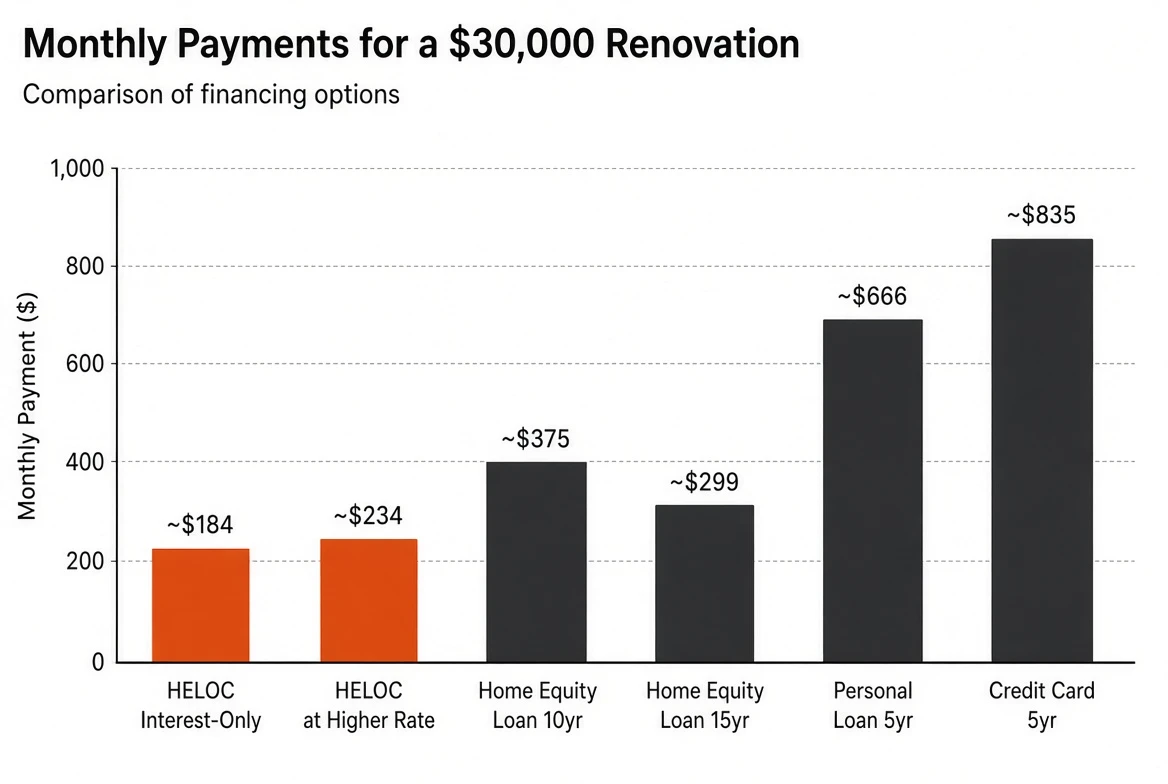
For example, this is simple math, not a quote. It uses the recent averages above for a $30,000 project. However, your own offer will differ, and fees are not included. Therefore, always run the numbers with a current lender quote.
| Option (rate used) | Monthly payment | Total interest if paid as shown |
|---|---|---|
| HELOC at 7.36%, interest-only during draw | About $184 a month, and the $30,000 is still owed | Interest keeps accruing until you repay principal |
| Same HELOC if the rate rises 2 points to 9.36% | About $234 a month | A reminder that variable rates move |
| Home equity loan at 8.7%, 10 years | About $375 a month | About $15,000 |
| Home equity loan at 8.7%, 15 years | About $299 a month | About $23,800 |
| Personal loan at 11.9%, 5 years | About $666 a month | About $9,950 |
| Credit card at ~22.4%, paid off in 5 years | About $835 a month | About $20,100 |
Notice two things. First, a longer term lowers the payment but raises the total interest. Second, an interest-only payment feels cheap, but it does not shrink your debt. In contrast, for a cash-out refinance, the math is different: adding $30,000 to a 30-year mortgage at 7.24% adds about $204 a month, but the new rate also applies to your entire balance, so compare the full before-and-after payment with a lender.
Can you deduct the interest?
Sometimes. Specifically, the IRS says interest on a home equity loan or HELOC is deductible only if you use the money to buy, build, or substantially improve the home that secures the loan. Also, it must be spent on that home, you generally have to itemize deductions, and total qualifying home debt is limited (currently $750,000 for most loans taken out after December 15, 2017). However, using the money for something else, like paying off cards, does not qualify. The rules are in IRS Publication 936.
Therefore, keep records of every improvement and how the loan money was spent. They also matter for your home’s “basis” when you sell. See tax basis and improvement records for how that works. Because the standard deduction is high for many households, the interest deduction only helps if your total itemized deductions exceed it. State tax treatment can differ. Therefore, ask a tax professional how this applies to your situation.
How to protect yourself
Know your three-day right to cancel
Federal law gives you three business days to cancel a home equity loan, HELOC, or the new money in a cash-out refinance on your primary residence. The window starts after you sign and receive the required notices. Business days include Saturdays but not Sundays or legal holidays. For a home-secured loan, the contractor generally cannot start work or deliver materials until the period ends. Also, you must cancel in writing.

Shop and compare
- First, get quotes from at least three lenders, including a bank and a credit union.
- Second, compare the APR, fees, closing costs, rate caps, and any prepayment penalty, not just the headline rate.
- Also, ask what happens if rates rise, and what the payment becomes.
Watch for red flags
- First, watch for pressure to sign the same day, or a contractor who insists you use one lender.
- Second, be wary of “No payments for a year” offers with hidden deferred interest.
- Also, question big deposits before work starts. Use checking a bid before you borrow against it to review the terms.
- Finally, avoid paying a contractor in full without lien waivers. See paying contractors safely with lien waivers.

How much should you borrow?
- First, get written quotes and add a 10 to 20 percent cushion. For help with the cushion, see working out how much to borrow.
- Second, subtract the savings you are willing to use, keeping your emergency fund.
- Third, estimate the payment at today’s rate and at a rate 2 points higher.
- Then check that payment against your monthly budget, with room left for surprises.
- Next, check your equity. Example: a $400,000 home times 80 percent is $320,000. If you owe $250,000, the most a lender might allow is about $70,000. Real limits vary by lender.
- Finally, plan for extra costs. How extra costs inflate the loan you need shows how changes add up mid-project.

A simple decision guide
| Your situation | Price these options first |
|---|---|
| Small project you can finish in a few months | Savings, or a 0 percent card you will pay off in time |
| Mid-size project, solid equity, costs arrive in stages | HELOC and home equity loan quotes |
| One big project with a fixed price | Home equity loan, or cash-out refinance if your current rate is higher than today’s |
| Buying or refinancing a home that needs work | FHA 203(k), HomeStyle, or CHOICERenovation (confirm current program rules) |
| Little equity, or you do not want a lien on your house | Personal loan quotes, or phasing the work |
| Your current mortgage rate is low | Be cautious with a cash-out refinance; compare other options |
“Price first” means get real quotes, not commit. The best choice depends on your numbers. If your numbers point toward a total rebuild, see when the numbers point to rebuilding.
Frequently asked questions
What is the best way to finance a home renovation?
There is no single best way. After all, savings cost the least. Home-secured loans usually cost less than cards or personal loans, but they put your house at risk. Therefore, your credit, equity, project size, and timeline decide, so compare real quotes from multiple lenders.
Is a HELOC or a home equity loan better for renovations?
A HELOC suits projects paid in stages, but its rate is usually variable. In contrast, a home equity loan gives a lump sum with a fixed rate and payment, which suits one project with a known price. Therefore, compare fees and test the HELOC payment at a higher rate.
Is it smart to use a credit card for a remodel?
It can work for small costs you will pay off quickly, or with a promotional 0 percent offer you will finish paying in time. However, average card rates are above 21 percent, so long balances get expensive fast.
Can I get a loan to renovate a house I’m buying?
Yes. For example, renovation mortgages such as the FHA 203(k), Fannie Mae HomeStyle, and Freddie Mac CHOICERenovation combine the purchase and repair costs in one loan. However, rules and limits vary by year and location, so ask a lender experienced with these programs.
Is home equity loan interest tax deductible?
Only if you use the money to buy, build, or substantially improve the home that secures the loan, you itemize, and you stay within IRS limits. However, interest on money used for other purposes is not deductible. Therefore, ask a tax professional.
Can I cancel a home equity loan after I sign?
For a loan secured by your primary residence, yes. You generally have three business days after signing and receiving the required notices, and you must cancel in writing. However, this does not apply to loans on rental or second homes.
Final thoughts
Money decisions get easier when you replace dread with arithmetic. First, write the quote down. Then add the cushion. Next, price three options. After that, test the payment at a worse rate than today’s. Finally, ask yourself one plain question: would this payment still feel okay in a tough year?
If the answer is yes, you have found a plan. However, if it is no, you have found out early, which is the cheapest time to change course. Either way, you will be making the decision with your eyes open. Therefore, confirm every rate, fee, and program rule with a licensed lender and, for tax questions, a tax professional before you sign.

Keep planning your project
More practical, plain-English guides on costs, permits, design, and hiring from the RemodelPulse team.