



Finding a contractor feels a lot like dating, with a license number. Everyone acts charming on the first visit. Everyone claims they are reliable. And you are about to hand a stranger the keys to your house and a large part of your savings.
The hard part is that charm and skill are different things. A friendly contractor can still be disorganized. A gruff one can still do excellent work. What separates good contractors from bad ones is rarely personality. Instead, it is paperwork, references, and habits you can check before you sign anything.
This guide gives you 12 steps that work. It includes real facts from state consumer agencies, the questions you should ask, the red flags you should watch for, and a safe way to pay. We wrote it for US homeowners. Where rules differ by state, we point that out clearly.
The short answer
Hire only a licensed contractor (and verify the license yourself). Confirm insurance and workers’ compensation. Get at least three written bids for the same scope. Check references and past work in person. Put everything in a written contract. And never let payments get ahead of the work. California’s contractor board gives this same advice in its “10 Tips” guide, and the approach works almost everywhere.
A note on state rules
Licensing, deposit limits, and contract rules differ by state. We use California as an example below because its Contractors State License Board publishes detailed guidance. Still, check your own state’s licensing board and attorney general’s consumer office. You can find them quickly through USA.gov’s state consumer directory.

The 12 steps
Step 1: Know what you want before you call anyone
Contractors can only quote what you clearly describe. Therefore, write down the rooms, the must-haves, the style, and your budget range first. A clear scope produces comparable bids. A vague one produces random numbers. Set your number first by setting the budget before you call anyone. If you plan to borrow, start by lining up the money first.
Step 2: Learn your state’s license rules
Most states license contractors, but the rules vary. In California, for example, the contractor board requires a license for anyone who contracts for or bids on construction work valued at $1,000 or more (labor and materials combined). Other states set different dollar limits or license by trade or by county. As a result, your state licensing board’s website is the best place to learn what applies where you live.
Step 3: Build a short list from trusted sources
Start with people who recently finished a project like yours: neighbors, friends, coworkers, and local suppliers or lumber yards. Trade associations and your local building department can also point you toward reputable contractors. Houzz’s 2026 study found that 91 percent of renovating homeowners hire professionals, with general contractors the most used at 29 percent. Because the field is crowded, aim for five names so that three can survive screening.

Step 4: Screen by phone
A ten-minute call saves hours later. Ask whether they are licensed, insured, and available. Ask what size projects they usually handle, how long it would take to start, and who will work on site. At the same time, notice how they communicate. Do they return calls promptly? Do they answer clearly and explain things without talking down to you?
Step 5: Verify the license yourself
Never take a license number on faith. The CSLB tells consumers to check a contractor’s license number online or by phone, to ask to see the contractor’s pocket license and a photo ID, and to make sure the names match. Most states offer a free online lookup that also shows complaints or legal actions. Therefore, do the same check in your own state.

Step 6: Confirm insurance and workers’ compensation
Ask for proof of general liability insurance, which covers accidental damage, and workers’ compensation insurance for employees. California’s contractor board says you should confirm workers’ comp coverage for employees. In addition, the written contract must include information about both types of insurance. Ask the contractor to have the insurer send the certificate directly to you.
Step 7: Check references and see past work in person
The CSLB recommends getting three references from each bidder and reviewing past work in person. Call those references and ask real questions. Did the contractor finish on time and on budget? How did they handle surprises? Did they keep the site clean? Would you hire them again? If possible, visit a finished job yourself.
Step 8: Get at least three written bids on the same scope
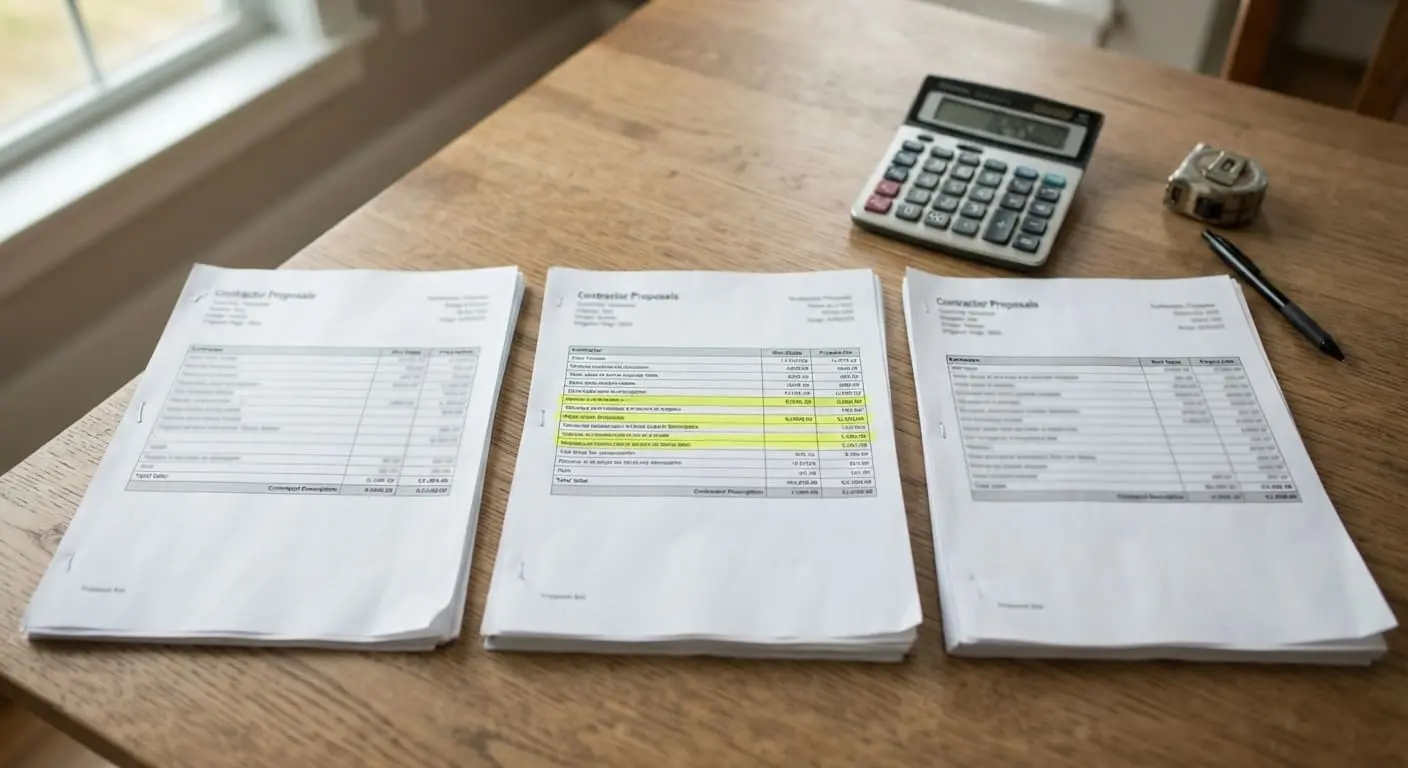
Every consumer agency repeats this advice for a reason. Give each contractor the same written scope, and then compare the bids line by line rather than by total price alone. Do not automatically take the lowest number. Our guide on what to look for once the bids arrive explains allowances, exclusions, and red flags in bids.
Step 9: Meet in person and trust your read
Choose your top two or three candidates for a visit. Notice whether they ask smart questions about your house, explain trade-offs honestly, and give a realistic start date. Be careful with charm and pressure. A contractor who rushes you or claims a price is only good today makes it hard to complete the checks above. In fact, the CSLB flags pressure for an immediate decision as a common scam tactic.
Step 10: Check complaints and disputes
Look at your state board’s record. Also consider local consumer agencies, the attorney general’s office, and review sites. Treat online reviews as clues rather than final verdicts, since some people push or fake them. A single bad review matters less than a clear pattern. Moreover, the way the contractor responded to criticism often matters most.
Step 11: Read the contract like it is the project
The contract is the project. It should include the scope, materials, price, schedule, payment schedule, who pulls permits, cleanup, warranty, and how the parties will handle changes. The CSLB says the contract must include a payment schedule for the whole job and that all changes (change orders) must appear in writing and carry both signatures. Never sign a blank or partly blank contract. For changes, see keeping changes in writing. For permits, see who pulls the permit.

Step 12: Pay safely and start well
- Keep the down payment small. California law limits it to 10 percent of the contract price or $1,000, whichever is less. Other states differ, so ask your state board.
- Do not pay in cash, and keep every receipt. The CSLB also advises against letting payments get ahead of the work.
- Tie payments to progress, not calendar dates, and hold back the final payment until the last inspection passes.
- Collect lien waivers from the contractor and subcontractors before you pay. See why unpaid subs matter.
- Keep a job file with the contract, change orders, receipts, and photos.
- Hold a kickoff meeting. Agree on work hours, access, communication, and the plan for dust and noise. See agreeing on dust and access rules.
If you are planning a kitchen, where hiring fits in a kitchen project shows when to bring a contractor in. Meanwhile, the order contractors will follow explains the usual sequence.
Questions to ask every contractor
- Are you licensed in this state, and may I see your license and a photo ID?
- Can you send proof of general liability and workers’ compensation insurance?
- Have you done projects like mine? Can I speak to three recent customers?
- Who will be on site each day: your crew or subcontractors?
- Will you pull the permits, and what inspections should I expect?
- What is your payment schedule, and what is tied to each payment?
- How do you handle changes and surprises?
- Who cleans up each day, and who removes debris?
- What warranty do you offer on labor, and is it in writing?
- How many jobs do you run at once, and what is a realistic start and finish date?

Red flags
| Red flag | Why it matters |
|---|---|
| Asks for a big down payment or cash | Consumer boards say to avoid it. California caps deposits at 10 percent or $1,000, and scammers often claim they need cash for materials |
| Pressure to decide today | Makes it impossible to get three bids and check licenses and references |
| No license, or a license number that does not check out | You lose legal protections, and in some states unlicensed work cannot be enforced |
| Door-to-door offers of cheap “leftover materials” | A classic storm-chaser and scam pattern |
| Vague scope or no written contract | Disputes start where the paper stops |
| Refuses to share references or insurance proof | A good contractor expects these questions |
| Asks you to pull the permits | The contractor should normally handle them |
| Bid far below the others with no explanation | Often means missing scope, no permits, or change orders later |
Where to look, and what to trust
| Source | Good for | Watch out for |
|---|---|---|
| Friends, neighbors, and coworkers | Honest accounts of real projects | A job on one house may not match yours |
| Local suppliers and lumber yards | They see who pays and who works well | They may favor customers who buy from them |
| Trade associations and the building department | Credentials and code knowledge | Membership is not a guarantee |
| Online reviews | Patterns across many reviews | Reviews can be pushed or faked, so read the middle ones |
| State licensing board | License status, bond, insurance, and legal actions | Records may lag behind |
| Lead-generation websites | Convenient lists | Contractors may pay to appear on the list |
Frequently asked questions
How do I find a good contractor?
Get referrals from people who recently completed similar work. Verify each contractor’s license and insurance yourself. Check three references and past work. Get at least three written bids on the same scope. Finally, put everything into a written contract.
How do I check a contractor’s license?
Use your state licensing board’s website or phone line. In California, the CSLB offers a free online and phone license check. It also advises you to ask to see the contractor’s pocket license and photo ID and to make sure the names match.
How many bids should I get?
Get at least three, and make sure each one is based on the same plans and scope. Do not automatically choose the lowest price. Instead, compare what each bid includes, the materials, and the proposed schedule.
How much deposit is normal?
It depends on your state. California limits a home improvement down payment to 10 percent of the contract price or $1,000, whichever is less. Other states have different rules, and some have none. In any state, avoid cash and do not let payments get ahead of the work.
What insurance should a contractor have?
A contractor should carry general liability insurance for accidental damage and workers’ compensation if they have employees. Ask for proof, and have the insurer send the certificate directly to you.
What should I do if a contractor does a bad job?
Document everything. Put your complaints in writing and give the contractor a chance to fix the problems. If that fails, contact your state licensing board, the attorney general’s consumer office, and a lawyer if needed. Keep your job file complete.
Final thoughts
The best contractors are usually busy, organized, and a little relieved when a homeowner asks careful questions. They know the paperwork protects both sides. In contrast, the ones who get defensive when you ask for a license or a contract are telling you something useful.
So take your time, complete the checks, and trust the process more than the pitch. A good contractor is not found by luck. Instead, you find them through a few unglamorous steps that you can take this week.

Keep planning your project
More practical, plain-English guides on costs, permits, design, and hiring from the RemodelPulse team.