



You have a quote, a plan, and a lot of equity in your house. Then the lender asks the question that stops most people cold: “Do you want a line of credit or a loan?” They sound almost the same. They are not.
A HELOC and a home equity loan both borrow against your home’s value, and both can fund a renovation. But they behave very differently once the money starts moving. One is flexible and variable. The other is fixed and predictable. Picking the wrong one for your project can cost you real money or real sleep.
This guide compares them side by side using current US numbers, shows the payments on a $30,000 project, explains the risks that lenders rarely lead with, and gives you a simple way to choose. Rates were checked in late October 2026 and move often, so treat them as snapshots.
Please read this first
This is general information, not financial, tax, or legal advice. Both products use your home as collateral, which means missed payments can lead to foreclosure. Talk to a licensed lender, and for tax questions, a tax professional.
The short answer
A home equity loan gives you a lump sum at a usually fixed rate with fixed payments, which suits a single project with a known price. A HELOC is a credit line with a usually variable rate that you draw as needed, which suits a project paid in stages or with an uncertain total. The HELOC is more flexible, and the home equity loan is more predictable.

The core difference in plain words
Think of it like paying for dinner. A home equity loan is a set menu: you receive the full amount at closing, and you start repaying that same amount on a fixed schedule. A HELOC (home equity line of credit) is an open tab: you have a limit, you charge what you need during a “draw period,” and you pay back later.
- Home equity loan: a lump sum, usually a fixed rate, a fixed term (commonly 5 to 15 years, and sometimes longer), and the same payment every month.
- HELOC: a revolving credit line with a rate that is usually variable and tied to the prime rate. Most follow a pattern of about a 10-year draw period (some offer 5 or 15), then a repayment period of about 20 years.
The Consumer Financial Protection Bureau explains how lines of credit work on its HELOC page. Lenders commonly cap total borrowing, counting your mortgage, at about 80 to 85 percent of your home’s value.
Side by side
| Feature | HELOC | Home equity loan |
|---|---|---|
| How you get the money | A credit line you draw from as needed | One lump sum at closing |
| Interest rate | Usually variable, tied to prime. Some lenders let you lock part of the balance at a fixed rate | Usually fixed |
| Monthly payment | Varies. Often interest-only during the draw period, then principal and interest | Fixed from day one |
| Interest charged on | Only what you have drawn | The full amount from day one |
| Term | Draw period about 5 to 10 years, then repayment about 10 to 20 years | Fixed term, often 5 to 15 years |
| Closing costs | About 2 to 5 percent of the amount in many cases, though many lenders reduce or waive them | About 2 to 5 percent, similar |
| Flexibility | Borrow, repay, and borrow again during the draw period | None. For more money you need a new loan |
| Best for | Projects paid in stages, or with uncertain costs | One project with a known price |
A tip on fees: some lenders waive closing costs but charge them back if you close the line within a set time, often about three years. Read the fine print, and remember that a quoted APR may not include every closing cost.
What each costs right now
| Product | Recent national average | Source |
|---|---|---|
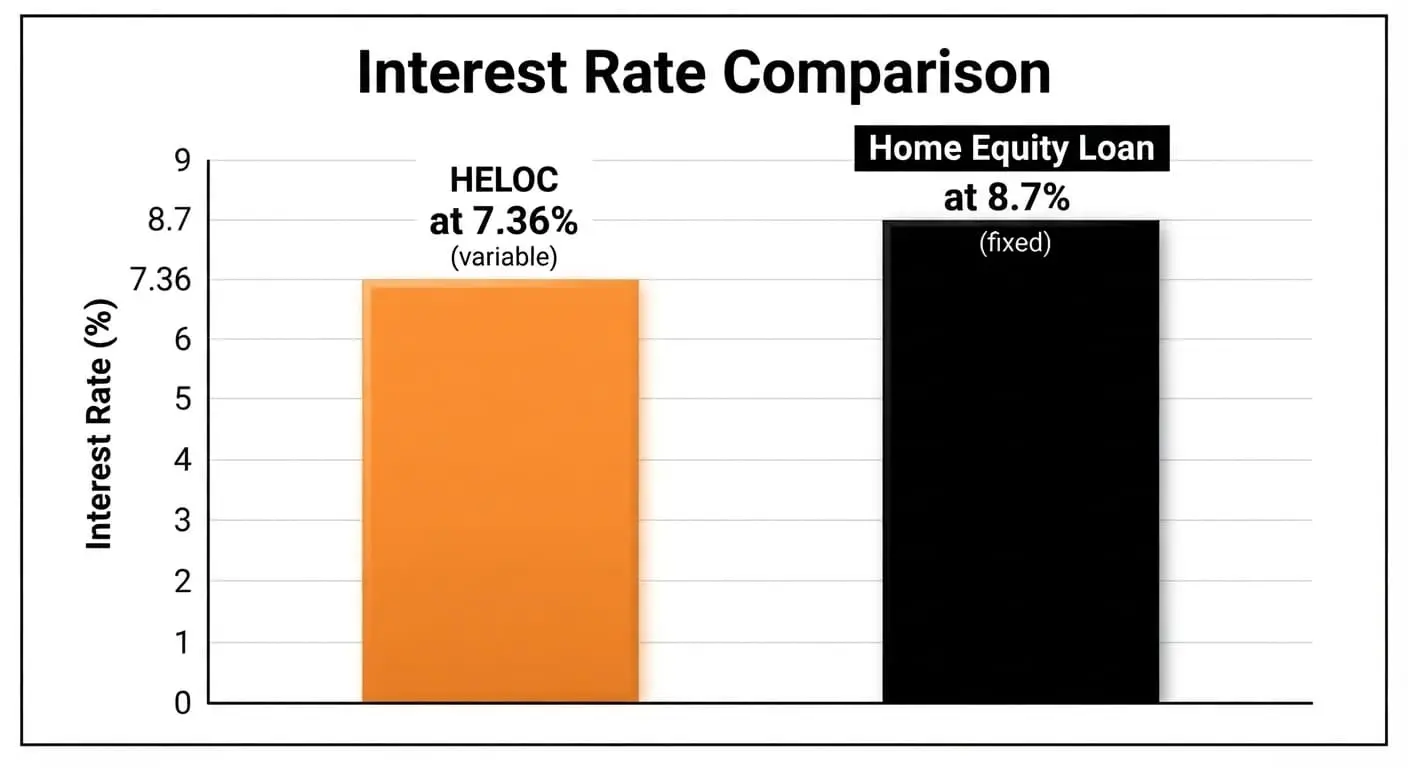
| HELOC (variable) | About 7.36 percent | Bankrate, October 28, 2026 |
| Home equity loan (fixed) | About 8.7 percent | Bankrate, October 21, 2026 |
Notice that the HELOC’s starting rate is lower, but it is variable, so it can rise. The home equity loan’s rate is higher, but it is locked. Your offer will depend on your credit, income, equity, and lender, so get quotes from at least three lenders, including a bank and a credit union.
What $30,000 looks like under each
This is simple arithmetic using the recent averages above. It is not a quote, and fees are not included.
| Scenario | Monthly payment | Notes |
|---|---|---|
| Home equity loan at 8.7 percent, 10 years | About $375 | About $15,021 total interest |
| Home equity loan at 8.7 percent, 15 years | About $299 | About $23,811 total interest. Lower payment, more interest |
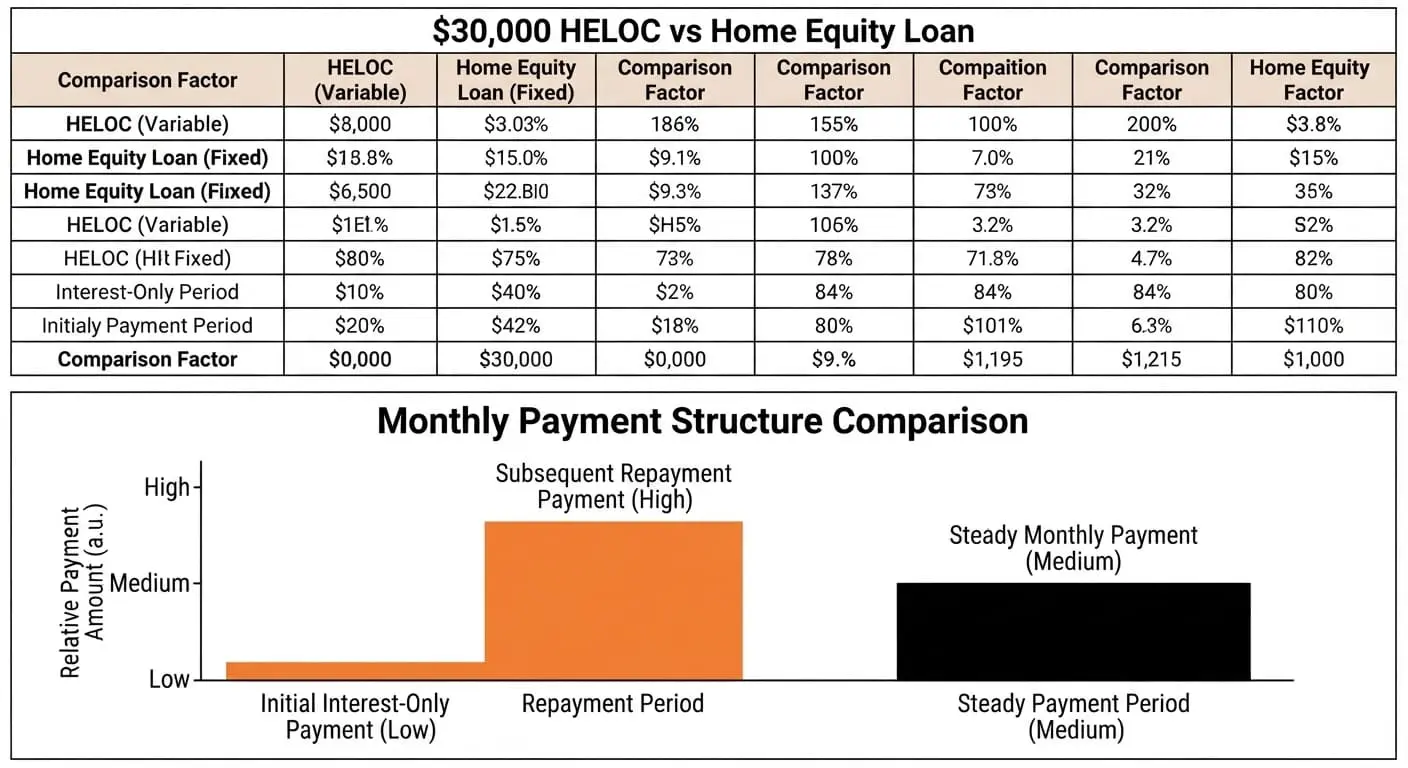
| HELOC at 7.36 percent, interest-only during the draw | About $184 | The $30,000 is still owed |
| Same HELOC if the rate rises 2 points to 9.36 percent | About $234 | A reminder that variable rates move |
| HELOC repayment phase, 20 years at 7.36 percent | About $239 | Payment jumps once principal is due |
| Same repayment phase at 9.36 percent | About $277 | Higher rate, higher payment |
Look at the jump. If you pay only interest during the draw period, your payment might be about $184 a month. When repayment starts, it can rise to about $239 at the same rate, because you are now paying down the principal too. Lenders and consumer guides call this payment shock. If the whole $30,000 sat for ten years at interest-only payments and then repaid over 20 years at a steady 7.36 percent, you would pay about $49,468 in total interest. Paying some principal during the draw period reduces that.
The risks lenders mention quietly
- Your home is collateral. For both products, missed payments can lead to foreclosure.
- Variable rates (HELOC). Most HELOCs use an index such as prime plus a margin, so your payment can climb.
- Payment shock (HELOC). Payments often rise sharply when the draw period ends.
- Frozen or reduced lines (HELOC). Consumer guides note that lenders can reduce or freeze a HELOC if your home value falls or your finances change, even if you were counting on it for a later stage of the project.
- Over-borrowing. A line of credit is easy to keep using. Houzz found that 35 percent of renovators went over budget by choosing pricier materials and 31 percent expanded the project, so set a firm cap.
- Prepayment penalties and fees. Check for penalties on early payoff and for charges if you close a line early.
Some lenders let you lock part of a HELOC balance at a fixed rate, or convert to fixed later, but the fixed rate is usually higher than the variable one, and the terms vary. Ask what is available before you sign. A project that grows after you borrow is a classic trap, so read why a project grows after you borrow.
Taxes and your right to cancel
The IRS says interest on a home equity loan or HELOC is deductible only if the money is used to buy, build, or substantially improve the home that secures the loan, you itemize deductions, and your total qualifying debt stays within limits (currently $750,000 for most loans). Using the money for other things does not qualify. See IRS Publication 936, and think about keeping receipts for tax time.
Federal law also gives you a three-business-day right to cancel a home equity loan or HELOC on your primary residence after you sign and receive the required notices. For a home-secured loan, the contractor generally cannot start work or deliver materials until that window closes. Cancel in writing.
Which one fits your renovation?
| Your project | Usually fits | Why |
|---|---|---|
| A bathroom or kitchen with a signed contract and fixed price | Home equity loan | One known number, fixed payment |
| A phased remodel over many months | HELOC | Borrow as each stage is paid |
| A fixer-upper with uncertain costs | HELOC, with a firm limit | Flexibility for surprises, but watch over-borrowing |
| You hate payment surprises | Home equity loan | Rate and payment are locked |
| You want lower initial payments and can handle changes | HELOC | Starting rates and interest-only payments are lower |
| You want both flexibility and stability | HELOC with a fixed-rate option, or a loan plus a small line | Ask lenders what they offer |
Before you choose, pinning down the amount you need helps you borrow only what the project requires, plus a cushion of 10 to 20 percent. For a wider look at every way to pay, read the full menu of ways to pay.

How to apply smartly
- Get firm quotes first. Getting firm quotes before you apply shows how to compare bids so you borrow against real numbers.
- Check your equity. Example: a $400,000 home times 80 percent is $320,000. If you owe $250,000, a lender might allow about $70,000. Real limits vary.
- Stress-test the payment. Check it at today’s rate and at 2 points higher, and for a HELOC check the repayment-phase payment too.
- Compare at least three lenders. Look at APR, fees, margin, rate caps, draw and repayment terms, and any prepayment penalty.
- Ask the freeze question. “Under what conditions can you reduce or freeze my line?”
- Protect yourself when paying. Paying contractors from loan draws safely explains lien waivers so a subcontractor’s unpaid bill does not become your problem.

Frequently asked questions
What is the main difference between a HELOC and a home equity loan?
A home equity loan is a lump sum with a usually fixed rate and fixed payments. A HELOC is a credit line with a usually variable rate that you draw from as needed. Both are secured by your home.
Which is better for a home renovation?
It depends on the project. A home equity loan suits one project with a known price. A HELOC suits staged projects or uncertain costs. Compare quotes, and test the HELOC payment at a higher rate.
Is a HELOC rate higher or lower than a home equity loan rate?
Recently, average HELOC rates were lower, about 7.36 percent against about 8.7 percent for home equity loans, but HELOC rates are usually variable and can rise.
Can my HELOC be frozen?
Yes. Consumer guides note lenders can reduce or freeze a HELOC if your home’s value drops or your finances change. Ask your lender about the conditions.
Is HELOC or home equity loan interest tax deductible?
Only if the money is used to buy, build, or substantially improve the home that secures it, you itemize, and you stay within IRS limits. Ask a tax professional.
Can I cancel after I sign?
For a loan on your primary residence, yes. You generally have three business days after signing and receiving the required notices, and you must cancel in writing.
Final thoughts
Neither product is good or bad. A HELOC is a flexible tool that rewards discipline. A home equity loan is a steady tool that rewards planning. The right pick is the one that matches how your project will actually spend money, and how you would feel if the rate rose or the line froze.
So write down your real number, add a cushion, price three lenders, and test the payment at a worse rate than today’s. If it still feels comfortable, you have your answer.

Keep planning your project
More practical, plain-English guides on costs, permits, design, and hiring from the RemodelPulse team.